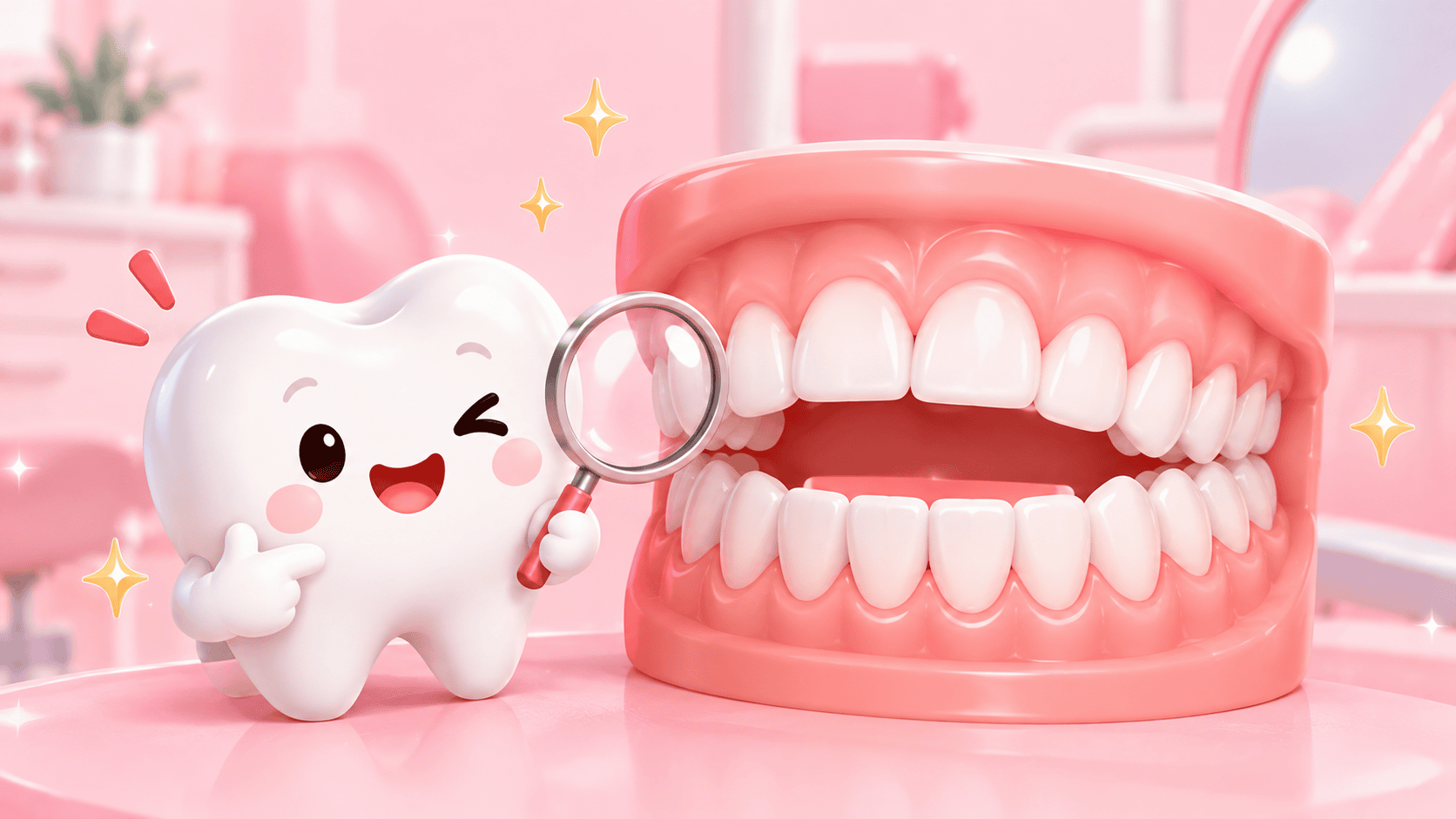
If your upper and lower teeth do not touch when you close your mouth, or you have noticed the same gap in your child’s smile, it is natural to wonder whether it is serious and whether it can be corrected. An open bite is a recognised bite problem, and in most cases it can be treated. The right approach depends on what is causing it and on the patient’s age.
Below, you will find how dentists tell the types of open bite apart, what usually causes it, and which treatments are used at different ages. It is written to help you decide whether to wait, monitor or book an assessment.
What Is an Open Bite?
An open bite is a type of malocclusion, the dental term for teeth that do not fit together properly. When you close your mouth and bite down, a gap remains between some of your upper and lower teeth, so they cannot meet.
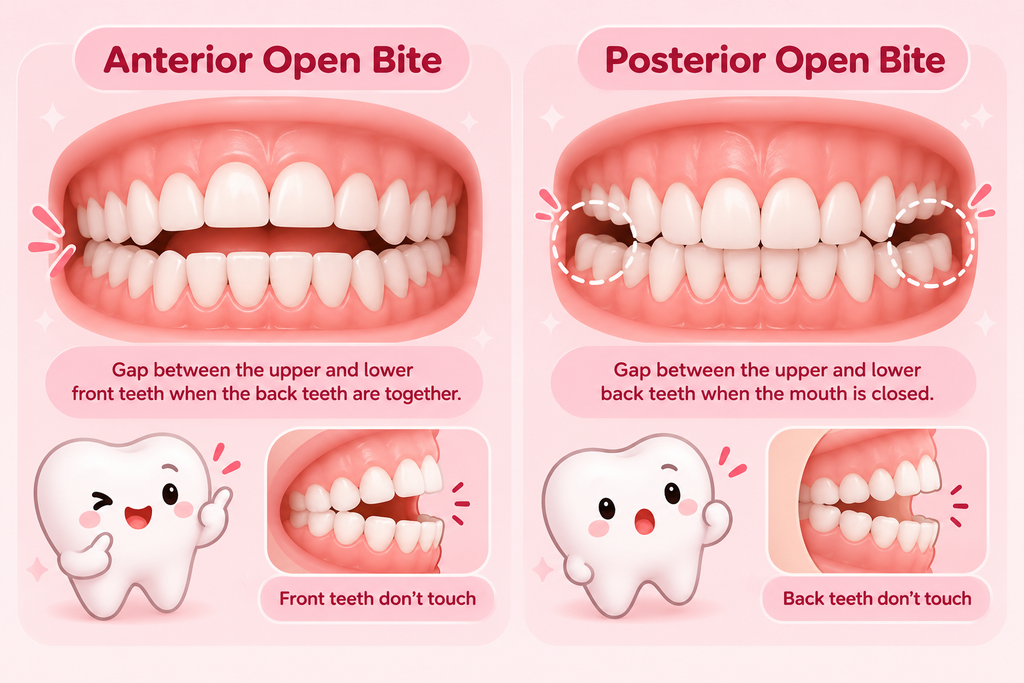
In an anterior open bite, the front teeth stay apart while the back teeth meet normally. It is less common than many other bite problems, but in most cases it can be corrected once the cause is understood.
Anterior Open Bite vs Posterior Open Bite
Dentists describe an open bite by where the gap sits. Most people who say “open bite” mean the anterior type, but a posterior open bite also exists and can feel quite different.
| Type | What it looks like | What patients often notice |
|---|---|---|
| Anterior open bite | A gap between the upper and lower front teeth when the back teeth are together | Difficulty biting into food with the front teeth, a lisp, or the tongue showing between the teeth |
| Posterior open bite | A gap between the upper and lower back teeth when the mouth is closed | Less efficient chewing, often linked to jaw growth patterns or tooth eruption problems |
Dentists also look at whether the cause is dental, meaning tooth position or habits, or skeletal, meaning the way the jaws have grown. That distinction shapes the treatment plan.
Open Bite Symptoms
Some people spot an open bite in the mirror, while others only notice it when eating or speaking becomes awkward. Common signs include:
- Upper and lower teeth that do not touch when the mouth is closed
- Difficulty biting into food such as sandwiches or fruit with the front teeth
- A lisp or other changes in speech
- A tongue that pushes forward between the teeth when swallowing or speaking
- Faster wear on the back teeth, which take on more of the chewing load
Also Read: Crossbite: Causes, Signs and Treatment in Singapore
Open Bite Causes
An open bite rarely has a single cause. Dentists usually consider habits, jaw growth and the jaw joint together.
Thumb Sucking and Pacifier Use
Sucking on a thumb, pacifier or other object in childhood can keep the front teeth apart. The longer the habit continues, the more severe the resulting bite can be. If the habit stops early, while a child still has baby teeth, the bite can often close on its own.
Tongue Thrusting
Pushing the tongue forward against or between the front teeth when swallowing or speaking applies steady pressure over time. Open bite is the most common alignment problem seen with tongue thrust.
Jaw Growth and Genetics
Some open bites come from how the jaws grow, for example when the lower jaw grows downward more than usual. These skeletal patterns are often influenced by genetics and usually need more than habit change alone to correct.
Mouth Breathing and Other Childhood Factors
Bite problems more broadly can also be linked to childhood mouth breathing, early loss of milk teeth and injuries that shift the jaw, so a dentist will ask about these during an assessment.Jaw Joint Changes
Jaw Joint Changes
Problems with the temporomandibular joint (TMJ) can lead people to shift their tongue and jaw posture, which may create an open bite. In rare cases, a sudden and rapid open bite, more commonly seen in adolescent females, can be linked to changes in the jaw joint and should be assessed promptly.
How an Open Bite Is Diagnosed
Diagnosis starts with a dental examination, but understanding why the bite is open matters just as much as seeing that it is.
Clinical Examination
- Checks how your teeth meet when you bite down and where the gap is
- Reviews habits such as thumb sucking, tongue posture and mouth breathing
- Asks about chewing, speech and jaw discomfort
X-Rays and Records
- X-rays to assess tooth positions and jaw structure
- Impressions or scans of the teeth to plan treatment
Referral When Needed
- Complex or skeletal cases may be referred for specialist orthodontic assessment
Open Bite Treatment
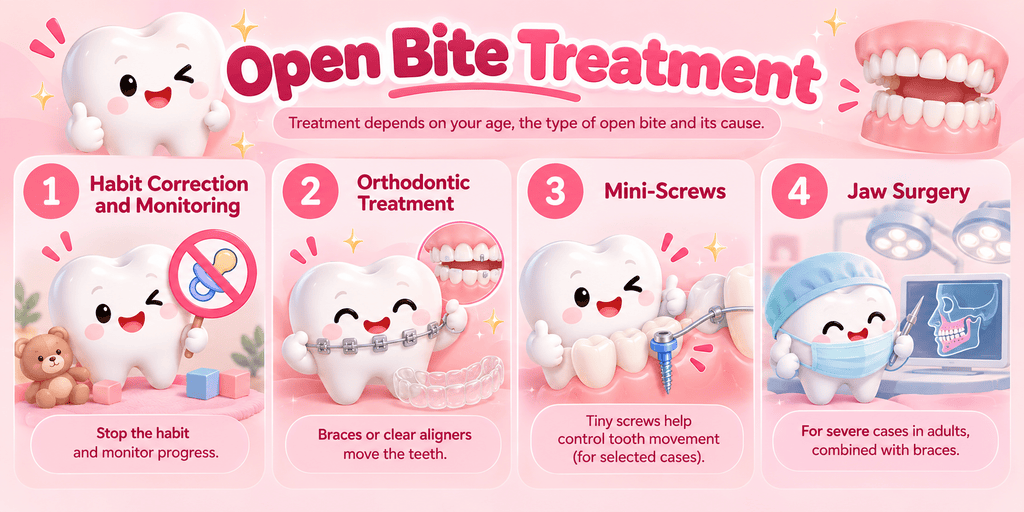
There is no single fix. Treatment depends on the patient’s age, the type of open bite and its cause. Dentists generally start with the least invasive option that can work.
Habit Correction and Monitoring
For young children with baby teeth, the first step is often to stop the habit and monitor progress. Where the tongue is involved, tongue therapy or a habit-breaking appliance may be recommended.
Orthodontic Treatment
Braces or clear aligners move the teeth so the upper and lower front teeth can meet. This is the most common route for children with permanent teeth and for adults, and it is covered in the next section.
Mini-Screws
For some adults, an orthodontist may place tiny temporary anchorage devices in the bone to help control tooth movement. Recent systematic reviews describe this as a less invasive alternative to surgery for selected patients, though relapse remains a concern.
Jaw Surgery
Orthognathic surgery is reserved for severe skeletal open bites, usually in adults whose jaws have finished growing, and is combined with braces. Specialists note that an open bite left untreated into late adolescence or adulthood can be complex, time-consuming and costlier to correct.
Open Bite Braces and Invisalign
Braces are the most common treatment for a dental open bite. At AllSmiles Dental Care, orthodontic treatment includes metal braces, ceramic braces and Invisalign, with the suitable option chosen after assessment.
Metal and Ceramic Braces
Fixed braces give continuous control over tooth movement. That is useful because open bite correction often involves bringing the front teeth together vertically while controlling the height of the back teeth.
Invisalign Clear Aligners
A scoping review of adult patients describes clear aligners as a promising alternative to fixed braces for anterior open bite, but notes that precise vertical control is challenging. Other reviews point to mild to moderate cases as the best fit and call for more high-quality studies, so case selection matters.
Also Read: What Is an Underbite? Causes, Signs & Treatment Options
How Long Do Braces for Open Bite Take
Braces for open bite are usually worn for about 12 to 24 months on average, followed by retainers. That is a general average across bite problems, not a promise for open bite specifically. Treatment time and cost both depend on the severity, the cause, the patient’s age, whether habits are corrected, and whether mini-screws or surgery are involved. A dentist can give a more accurate estimate after assessing your bite.
An open bite can also reopen after treatment, which is called relapse. Reviews link relapse to tongue posture, retention protocols and the underlying jaw pattern, so wearing retainers as advised and correcting tongue habits help protect the result.
Does Open Bite Need to Be Fixed?
Not every open bite needs treatment. A mild one that causes no trouble with eating, speaking, jaw comfort or tooth wear may only need monitoring, particularly in a growing child. Treatment is usually recommended when the bite affects function, comfort or oral health, or when the person wants to improve the look of their smile.
Waiting is not always neutral, though. Once the cause is established and growth has finished, an open bite is less likely to close on its own, and correction becomes more involved. An early assessment keeps more options open.
Preventing Open Bite in Children
You cannot prevent every open bite, as jaw growth and genetics play a part, but you can reduce habit-related risk by gently guiding your child away from thumb sucking and prolonged pacifier use. The Association of Orthodontists (Singapore) recommends that all children have an orthodontic screening by seven to eight years old, when adult teeth begin to appear. Regular children’s dental visits make it easier to spot early changes in how the teeth meet.
Get Your Bite Checked at AllSmiles Dental Care
See a dentist if your upper and lower teeth do not meet when you close your mouth, if biting, chewing or speech has become difficult, or if your bite seems to be changing, especially in a teenager. For children, an assessment while some baby teeth remain gives the most options.
At AllSmiles Dental Care, our dentists can examine your bite, explain what is behind it and discuss whether monitoring, braces or Invisalign is the right next step. Explore our orthodontic treatment and Invisalign services, browse all our dental services, or book an appointment at one of our islandwide clinics.
Frequently Asked Questions
What are the symptoms of open bite?
Common signs include upper and lower teeth that do not meet when the mouth is closed, difficulty biting into food with the front teeth, and a lisp. Some people also notice faster wear on the back teeth.
What causes open bite?
Thumb sucking, prolonged pacifier use, tongue thrusting and jaw growth patterns are the main causes. Jaw joint problems can also contribute in some cases.
Is open bite serious?
It is not usually an emergency, but it can affect chewing, speech and tooth wear. How much it matters depends on the type and severity, so a dental assessment helps clarify this.
Can open bite go away on its own?
In young children with baby teeth, it can close once a habit like thumb sucking stops. In older teenagers and adults, it is less likely to resolve without treatment.
Can Invisalign fix open bite?
Clear aligners can help correct mild to moderate anterior open bites in selected adult patients. Complex or skeletal cases may need braces, mini-screws or surgery, so suitability is decided after an assessment.