
If you are deciding between Invisalign and braces, you are really asking which one will straighten your teeth well without making daily life harder. Both work, and neither is better for everyone. The right choice depends on what is going on with your bite, how much routine you can commit to, and how you want your treatment to look.
Most people lean one way before they ever see a dentist, usually because of appearance or cost. That lean is worth testing against a few practical facts. These include which problems clear aligners handle well, how long each option really takes, and what it means to eat, brush and work with them every day.
Invisalign vs Braces
Invisalign is a series of clear, removable aligners made to fit your teeth. You move through the sets in order, and each one shifts your teeth a little closer to the planned position. Braces use brackets bonded to your teeth and joined by an archwire that your dentist adjusts over time. They come as metal braces, ceramic braces that blend with your tooth colour, and self-ligating braces that use clips instead of elastic bands.
The biggest practical difference is that aligners come out and braces do not. Removable means you can eat and clean normally, but your result depends on wearing them about 22 hours a day. Fixed braces work around the clock whether you think about them or not, which is why they remain the more dependable choice for difficult cases.
Key Differences at a Glance
The table below sums up the points patients ask about most. Your dentist will confirm how each one applies to your own teeth.
| Feature | Invisalign | Braces |
|---|---|---|
| Appearance | Clear aligners that are hard to notice | Visible brackets and wire, with metal and ceramic options |
| Removable | Yes, taken out to eat and brush | No, fixed until treatment ends |
| Eating and cleaning | Remove to eat, brush before putting back | Avoid hard and sticky foods, extra care around brackets |
| Best suited to | Mild to moderate alignment issues | Mild to severe issues, including complex bites |
| Typical treatment time | Often 9 to 15 months for suitable cases | Commonly 12 to 24 months, longer for complex cases |
| Daily commitment | About 22 hours of wear a day | Nothing to remember, as braces stay on |
Invisalign vs Braces Cost in Singapore
Cost is often the deciding factor, so here is a realistic picture. In Singapore, clear aligners usually cost more than conventional metal braces, while ceramic and self-ligating braces sit in between. The estimates below are general market ranges based on published fees from Singapore clinics. They are not a quotation, and the final figure can vary with GST, your case and the clinic.
| Option | Estimated cost (SGD) | Worth knowing |
|---|---|---|
| Metal braces | S$3,500 to S$6,000 | Usually the lowest-cost fixed option and effective for a wide range of cases |
| Ceramic braces | S$4,500 to S$7,000 | Tooth-coloured brackets that are less noticeable, but they can stain |
| Self-ligating braces | S$5,000 to S$7,000 | Clips replace elastic bands, so there is less friction and slightly more comfort |
| Invisalign (clear aligners) | S$3,500 to S$10,000 | Simple cases sit at the lower end, while complex cases cost more |
The range is wide because no two mouths are the same. Your quote depends on:
- How complex your bite is and how far your teeth need to move
- The type of appliance or aligner plan your dentist recommends
- The expected length of treatment and number of review visits
- Extras such as refinements, extractions and retainers
It also pays to ask whether a quote is all-inclusive, since some clinics bundle retainers and reviews while others price them separately.
For a quote based on your own teeth, you can contact AllSmiles Dental Care, where a dentist can assess your case and explain the cost of each suitable option.
Also Read: Loose Tooth: Causes & Treatment You Should Do
How Long Treatment Takes
Treatment time depends more on your case than on the appliance. HealthHub’s guidance on dental braces puts the typical range at 15 to 24 months, depending on how far teeth must move, how complex the case is and how closely you follow the plan. Suitable Invisalign cases are commonly planned over 9 to 15 months with around two dozen aligners, while braces typically stay on for 12 to 24 months.
So which is faster? Reviews of clinical studies give mixed answers. Some find aligners shorten treatment in mild to moderate cases, while others find no meaningful difference. For complex bites, braces can be quicker because brackets and wires give the dentist stronger control. Adults should also expect a longer course. With more adults in Singapore opting for braces, orthodontists note that adult teeth move through denser bone, and treatment usually runs at least six months longer than for teenagers.
Two things apply to both options. Aligners only stay on schedule if you wear each set about 22 hours a day, and leaving them out for long stretches slows progress. Whichever you choose, teeth tend to drift back once treatment ends, so you will need retainers as directed while the bone and gums stabilise, which can take up to a year.
Invisalign vs Braces Effectiveness
Both treatments can straighten teeth well when used for the right problem. Reviews of clinical studies conclude that clear aligners work well for mild to moderate crowding, spacing and alignment issues, but may fall short in severe cases and for certain tooth movements. In those situations, traditional braces vs Invisalign comes down to control, because fixed brackets can guide teeth in more directions at once. Singapore orthodontists likewise note that fixed braces may still be needed for complex cases.
The table below gives a general guide, although only a dental assessment can confirm what suits your teeth.
| Concern | Invisalign | Braces |
|---|---|---|
| Mild crowding or spacing | Often a good fit | Effective |
| Moderate crowding | Often possible, depending on the case | Effective |
| Severe crowding | May be limited | Often preferred |
| Overbite, underbite, crossbite or open bite | Possible when mild to moderate | Often used for complex bite correction |
| Tooth gaps | Often a good fit | Effective |
Pros and Cons of Invisalign vs Braces
The trade-offs show up most in everyday routines, including how you eat out in Singapore.
Invisalign Pros and Cons
Aligners are discreet and removable, which makes brushing, flossing and eating simple. You can enjoy a hawker centre meal as usual by taking them out, storing them in their case, and brushing before putting them back. The trade-offs are discipline and planning. Aligners come out only for meals and cleaning, drinks other than water mean taking them out, and a lost or damaged set can delay progress. They are also less suited to severe cases.
Braces Pros and Cons
Braces work around the clock, can correct a wide range of problems including complex ones, and cannot be left in a drawer or lost. Ceramic options are less noticeable than metal. The trade-offs are appearance and upkeep. Brackets and wires trap food and plaque, so brushing after meals and using an interdental brush matters. Hard or sticky foods such as ice, nuts, crab shells and toffee are best avoided or cut into small pieces. Regular scaling and polishing also helps keep your gums healthy during treatment.
How to Choose the Right Option
A few honest questions about your teeth and habits usually point to the better fit. Use these checklists as a starting point before your assessment.
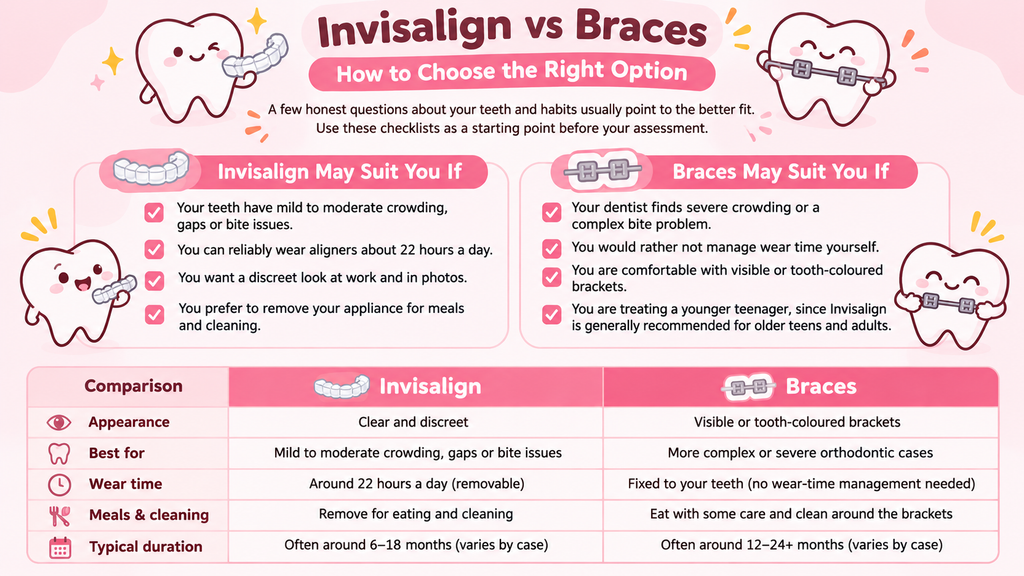
Invisalign May Suit You If
- Your teeth have mild to moderate crowding, gaps or bite issues
- You can reliably wear aligners about 22 hours a day
- You want a discreet look at work and in photos
- You prefer to remove your appliance for meals and cleaning
Braces May Suit You If
- Your dentist finds severe crowding or a complex bite problem
- You would rather not manage wear time yourself
- You are comfortable with visible or tooth-coloured brackets
- You are treating a younger teenager, since Invisalign is generally recommended for older teens and adults
What to Expect at Your Assessment
A proper assessment is the most reliable way to settle the choice. Your dentist examines your teeth, gums and bite, checks for cavities or gum disease that should be treated first, and may use X-rays or scans to plan tooth movement. Orthodontic treatment works best on healthy teeth and gums, so this step protects your final result.
From there, you can compare the options that suit your case in terms of appearance, time and daily routine, and ask about the expected timeline and cost before you commit. A good plan fits your teeth first and your lifestyle second, and it should explain clearly why your dentist recommends one option over the other.
Also Read: Open Bite: Types, Causes and Treatment
Find the Right Fit for Your Smile at AllSmiles Dental Care
At AllSmiles Dental Care, our dentists assess your teeth, gums and bite before recommending Invisalign, orthodontic braces or another option, so your plan is built around your case rather than a one-size-fits-all choice. With clinics across Singapore, fitting a consultation into your week is easy.
To find out whether Invisalign or braces suits you, explore our dental services or book an appointment with AllSmiles Dental Care today. We will walk you through your options, the expected timeline and the cost, so you can decide with confidence.
Frequently Asked Questions
Is Invisalign faster than braces?
Not always. For mild to moderate cases, Invisalign can be similar or slightly quicker, but studies give mixed results. Complex cases often move more predictably with braces, and your dentist can estimate timing once your teeth have been assessed.
Is Invisalign as effective as braces?
For mild to moderate problems, yes. Severe crowding and complex bite problems are usually better handled by braces, which is why an assessment comes before any decision.
How much do Invisalign and braces cost in Singapore?
As a general estimate, braces cost about S$3,500 to S$7,000 depending on the type, while Invisalign ranges from about S$3,500 to S$10,000 depending on case complexity. Your dentist can give an accurate quote after assessing your teeth.
Can I eat anything with Invisalign?
You take the aligners out to eat, so the appliance itself places no food restrictions on you. Brush your teeth before putting them back in, and only drink water while you are wearing them.
Can I use MediSave for Invisalign or braces?
Generally no. CPF Board advises that MediSave cannot usually be used for optional or cosmetic treatments, and orthodontics falls under that. Check with your clinic and your insurer about other options.