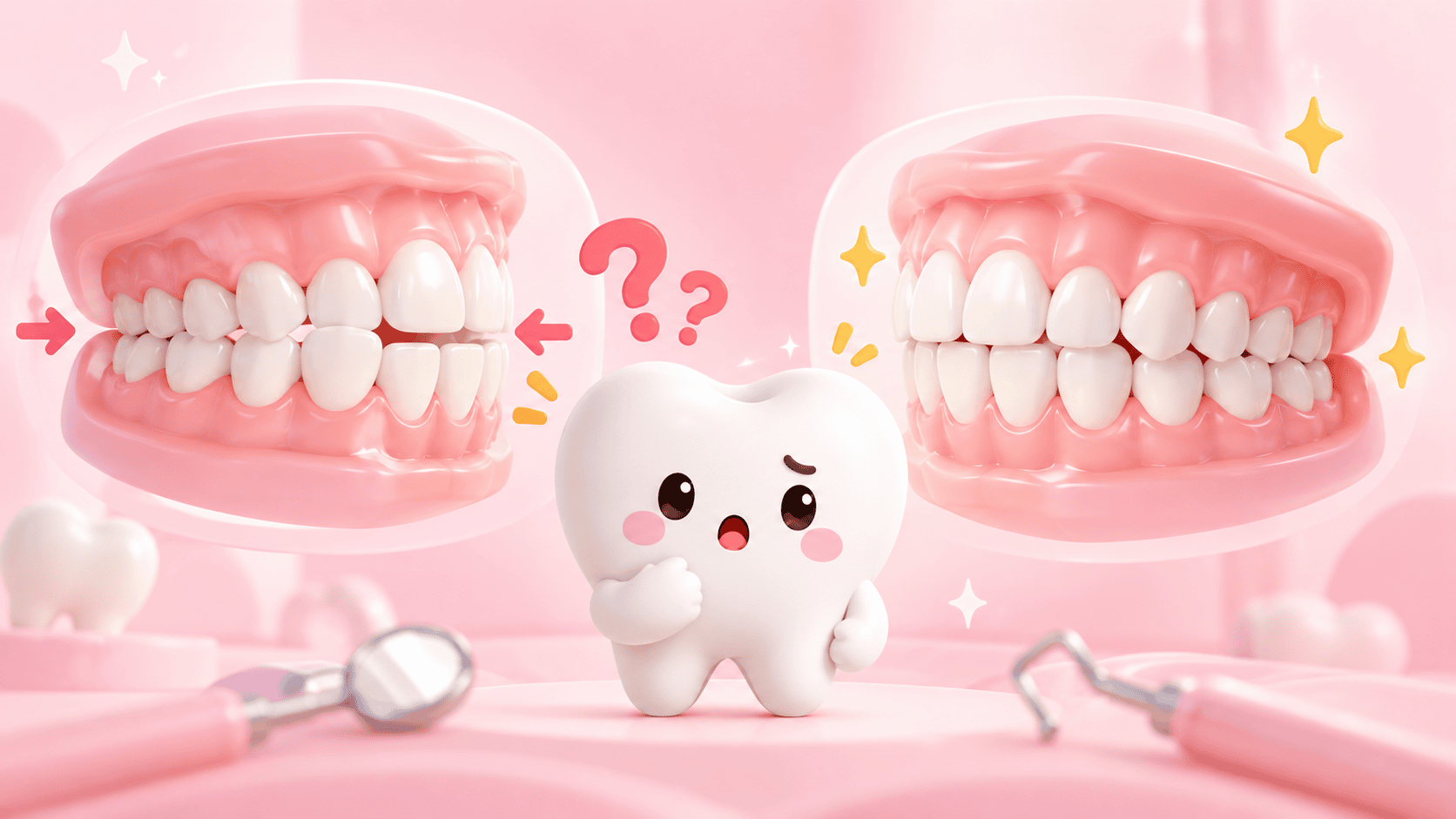
Many people only learn they have a crossbite when a dentist points it out, or when a child’s front tooth grows in behind the bottom teeth. It can look like a minor alignment quirk. But the way your teeth meet affects how you chew, how evenly your teeth wear and how comfortable your jaw feels.
This guide explains what a crossbite is, why it happens and how it is corrected in Singapore. It is written for adults as well as parents of young children.
What is Crossbite?
A crossbite is a bite problem where one or more upper teeth close inside the lower teeth, instead of slightly outside as they normally do. It can affect a single tooth, a group of teeth or one whole side of the mouth.
It is a type of malocclusion, which simply means the teeth or jaws do not meet as expected. Some crossbites come down to tooth position. Others involve the size or position of the jaws, and that difference shapes which treatment will work.
Crossbite Teeth and Common Signs
A crossbite is not always painful, so it can go unnoticed for years. Dentists usually spot it by looking at how your teeth close together, sometimes with scans or X-rays to see whether the cause sits in the teeth or the jaw.
Signs that may point to a crossbite include:
- Upper teeth that look tucked inside the lower teeth when you bite down
- A jaw that shifts to one side as you close your mouth
- Uneven wear, chipping or flat spots on certain teeth
- Gum recession around a tooth that takes more force than its neighbours
- Jaw tension or clicking, or difficulty chewing evenly
Type of Crossbite
Anterior Crossbite
An anterior crossbite affects the front teeth. One or more upper front teeth sit behind the lower front teeth, which can resemble an underbite. Over time, the lower front teeth can wear down or the gums around them can recede.
It is also the most common early orthodontic problem seen locally. In a study of 1,324 patient records at the National Dental Centre Singapore, anterior crossbite was the most prevalent diagnosis among children treated with interceptive orthodontics.
Posterior Crossbite
A posterior crossbite affects the back teeth. The upper molars or premolars close inside the lower ones, often because the upper jaw is narrow. It can affect one side or both.
When only one side is affected, the lower jaw may slide sideways to find a comfortable bite. That habit can lead to uneven wear and, in growing children, uneven jaw development.
The two types compare as follows.
| Feature | Anterior crossbite | Posterior crossbite |
|---|---|---|
| Teeth involved | Upper front teeth sit behind lower front teeth | Upper back teeth close inside lower back teeth |
| What you may notice | Front teeth bite reversed or edge to edge | Narrow upper arch, jaw shifting to one side |
| Possible effects | Wear on front teeth, gum recession on lower front teeth | Uneven molar wear, uneven jaw growth in children |
| Common approach in children | Bite plate or braces on the affected teeth | Palatal expander or other expansion appliance |
Crossbite Causes
Crossbite causes usually combine inherited traits and how the teeth and jaws develop. Knowing which one applies helps the dentist decide how early to act.
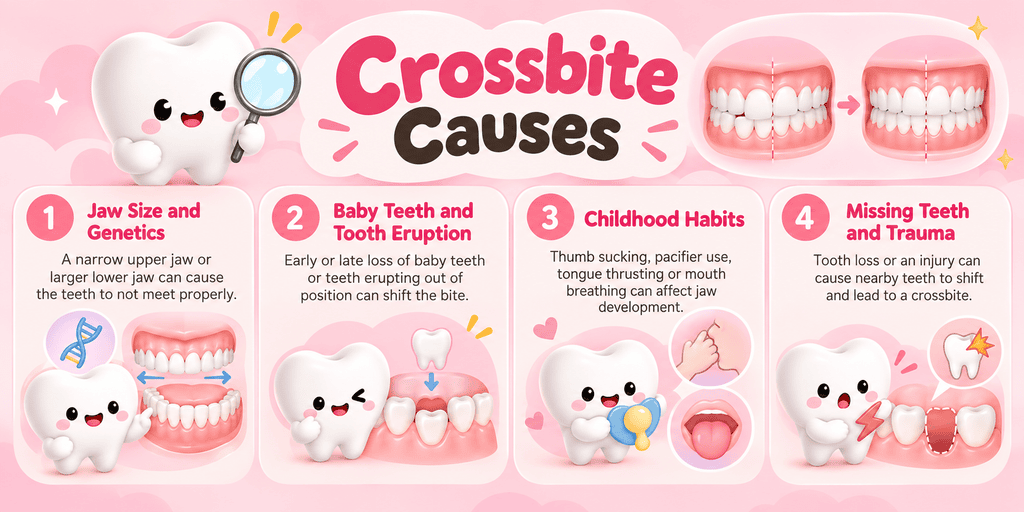
Jaw Size and Genetics
If the upper jaw is narrow or the lower jaw is relatively large, the teeth may not meet correctly no matter how well they erupt. This pattern often runs in families.
Baby Teeth and Tooth Eruption
If baby teeth are lost late or early, or adult teeth erupt out of position, neighbouring teeth can drift and the bite can shift. Crowding can push a tooth to one side of the arch and into a crossbite.
Childhood Habits
Prolonged thumb sucking, long-term pacifier use and tongue thrusting can change the shape of the palate over time. Chronic mouth breathing, for example from enlarged adenoids, may also affect how the upper jaw develops.
Missing Teeth and Trauma
Tooth loss lets other teeth tilt into the gap. An injury to a baby tooth can also change the path of the adult tooth that follows.
Also Read: Overbite: Symptoms, Causes & Treatment
Crossbite in Primary Dentition
Crossbite in primary dentition means a crossbite present while a child still has baby teeth. Parents often wonder whether it can wait until the adult teeth arrive.
The answer depends on the child. The Association of Orthodontists (Singapore), and NDCS advises an orthodontic assessment at around seven years old when early problems are seen. Not every crossbite needs immediate treatment, and some are simply monitored.
When treatment is needed, early correction is usually shorter and simpler. NDCS reports an average of 7.5 months with removable appliances and 11 months with fixed appliances. Treatment works best when the child wears the appliance as instructed, since poor compliance is the main reason it fails. A dentist can check for early signs at your child’s regular visit, and children’s dentistry is the natural place to start.
Crossbite Treatment
Crossbite treatment depends on whether the problem is dental (tooth position) or skeletal (jaw position), plus the patient’s age and how severe the bite is. The dentist confirms this through an examination, scans and X-rays before recommending a plan.
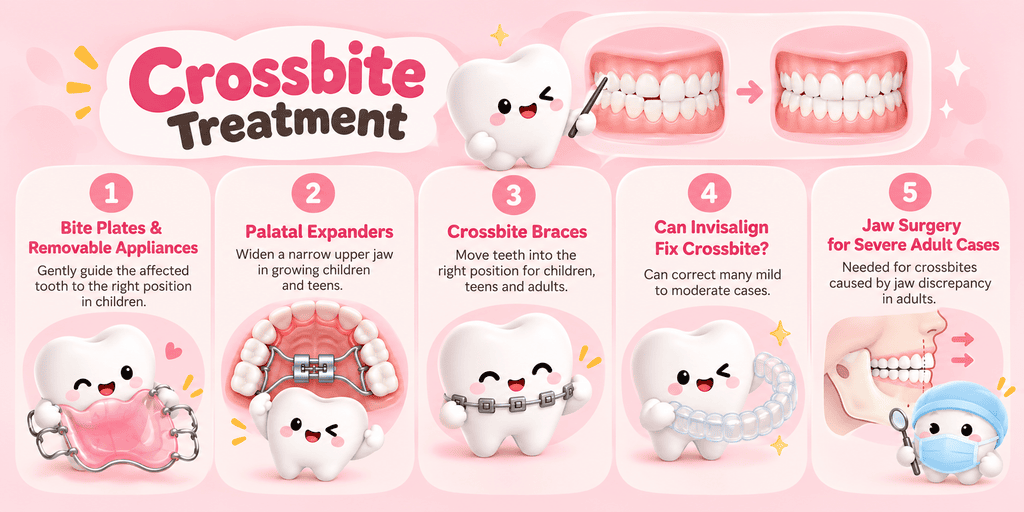
Bite Plates and Removable Appliances
For a child with an anterior crossbite, a bite plate can gently guide the affected tooth into the correct position. Removable appliances are used in the mixed dentition stage and need consistent wear to work.
Palatal Expanders
A palatal expander widens a narrow upper jaw, which corrects many posterior crossbites in growing children and teens. It works because the upper jaw is still developing, so it is most effective at younger ages.
Jaw Surgery for Severe Adult Cases
Adults with a crossbite caused by a real jaw discrepancy may need corrective jaw surgery combined with braces once growth has finished. This is the exception and is planned with an orthodontist and an oral surgeon. Many adult crossbites are dental and do not need surgery.
Crossbite Braces
Crossbite braces apply steady, controlled pressure to move teeth into the right position, and they suit a wide range of cases. They work for children, teens and adults, and they can shift individual teeth, whole arches or both. Ceramic braces are a less visible option than metal.
According to HealthHub, braces treatment typically takes about 15 to 24 months, followed by retainers to hold the result. Our orthodontic treatment page gives a similar range of 12 to 24 months for most patients.
Can Invisalign Fix Crossbite
Invisalign can correct many crossbites, particularly mild to moderate cases where tooth position is the cause. Attachments and small elastics are often used to move teeth in the right direction.
It is less predictable when the crossbite comes from a jaw size mismatch, or when many teeth need to move at once. In those cases, braces or an expander may work better. Suitability is confirmed through assessment and a digital scan. You can read more on our Invisalign page.
The table below summarises where each option tends to fit best.
| Option | Best suited for | Things to know |
|---|---|---|
| Bite plate or removable appliance | Children with an anterior crossbite | Needs consistent daily wear |
| Palatal expander | Growing children and teens with a narrow upper jaw | Most effective while the jaw is still growing |
| Braces | Children, teens and adults, including more complex cases | Typically 12 to 24 months, then retainers |
| Clear aligners | Teens and adults with mild to moderate tooth-position crossbites | May need attachments or elastics |
| Jaw surgery with braces | Severe skeletal crossbites in adults | Hospital-based and planned with specialists |
Also Read: What Is an Underbite? Causes, Signs & Treatment Options
Risks of Leaving a Crossbite Untreated
Not every crossbite causes problems, and some people live with a mild one comfortably. But an untreated crossbite can gradually add strain to teeth, gums and the jaw.
Possible effects include:
- Wear, chipping or cracking on teeth that take extra force
- Gum recession around the affected teeth
- Teeth that are harder to clean, which raises the risk of decay and gum problems
- Jaw discomfort or uneven chewing in some people
- Uneven jaw growth in children with an untreated posterior crossbite
Crossbite Treatment Cost and Financing in Singapore
Cost depends on the type of treatment, the complexity of your bite and how long treatment takes. Braces at Singapore clinics are commonly quoted from about S$3,500 and can exceed S$10,000 for complex cases. Invisalign at AllSmiles starts from S$3,500, depending on complexity. Always confirm what is included, such as scans, retainers and follow-up visits, and whether the quote is before or after 9% GST.
Routine braces and Invisalign are elective orthodontic treatment, so they are generally not claimable under MediSave, and most dental insurance plans do not cover them. Corrective jaw surgery for a functional problem may qualify for MediSave in selected cases, subject to MOH rules. Our MediSave dental page explains which procedures can be claimed.
Book a Crossbite Assessment at AllSmiles Dental Care
If you have noticed an upper tooth sitting inside a lower one, a jaw that shifts when you bite, or uneven wear on your teeth, an early check makes the next steps clearer. For children, a quick look during a routine visit can show whether the bite needs treatment now or just monitoring.
A short assessment tells you whether your crossbite is a simple tooth-position issue or something more involved. It also lets you compare options and costs before deciding anything.
At AllSmiles Dental Care, our dentists will examine your bite, take the scans or X-rays needed and explain whether braces, Invisalign or another approach suits you or your child. If your case needs specialist orthodontic care, we will advise you on the next step.
You can visit any of our clinics across Singapore. Book an appointment with AllSmiles Dental Care to find out what is causing your crossbite and how to correct it.
Frequently Asked Questions
Is a crossbite the same as an underbite?
Not quite. An underbite involves the lower jaw or all the lower front teeth sitting forward. A crossbite can involve just one tooth, a few teeth or one side of the mouth, though an anterior crossbite can look similar to an underbite.
Can a crossbite fix itself?
A crossbite in permanent teeth generally does not correct on its own. In young children with baby teeth, a dentist may monitor the bite first, since it can change as adult teeth come in.
Can a crossbite be fixed without surgery?
In most cases, yes. Braces, aligners, bite plates and expanders correct many crossbites without surgery. Surgery is usually reserved for severe skeletal cases in adults after growth has finished.
Can Invisalign fix a crossbite?
Often, for mild to moderate cases caused by tooth position. Cases involving the jaw, or several teeth, may need braces or an expander instead.
At what age should my child see a dentist about a crossbite?
Screening at around 7 to 8 years old is encouraged in Singapore. If you notice a tooth growing in behind the others, or the jaw shifting, have it checked earlier.