
Cavities are one of the most common dental problems in Singapore, yet most cases are entirely preventable with the right daily habits. Even with decades of water fluoridation, national health surveys still find tooth decay in a large share of both children and adults across the island, often developing quietly with no pain until real damage has already been done.
The good news is that preventing a cavity rarely takes more than consistency. A few adjustments to how you brush, what you eat between meals, and how often you see your dentist can dramatically lower your risk, whether you’re managing braces, watching an old filling, or simply trying to keep your natural teeth for life.
6 Ways to Prevent Cavities
Cavity prevention comes down to controlling the two things that cause decay in the first place: the bacteria living on your teeth, and the sugars and acids that feed them. Here’s how to prevent cavities without overhauling your entire routine — six practical habits that work whether you’re a teenager with braces or an adult managing years of dental history.
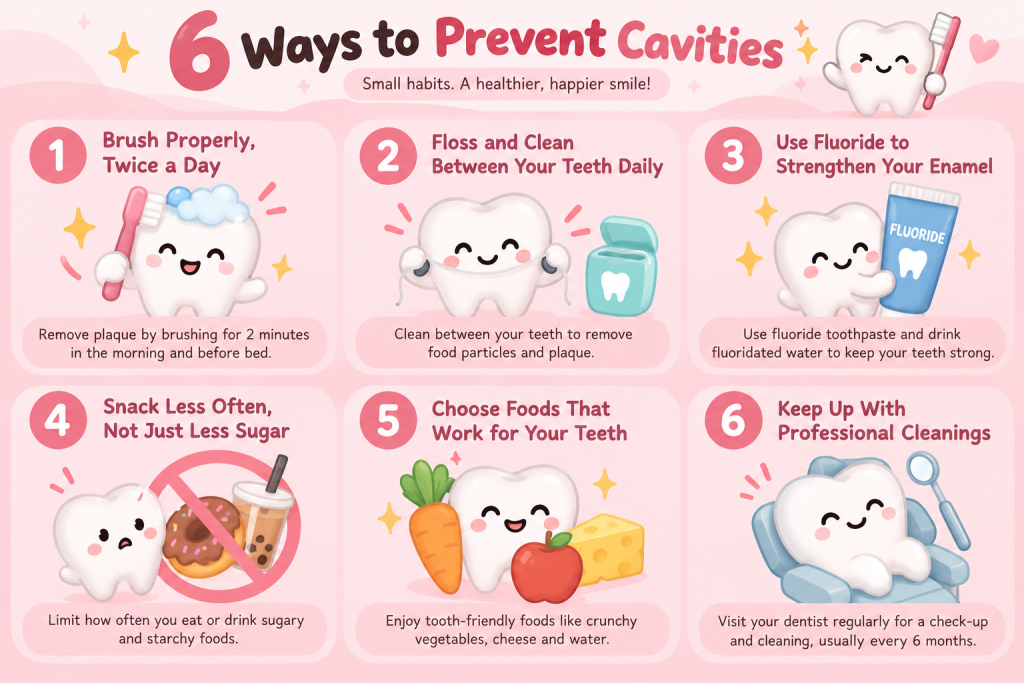
1. Brush Properly, Twice a Day
Brushing twice daily for two full minutes removes the plaque that fuels tooth decay, but technique matters as much as frequency. Angle the bristles slightly toward the gumline and use small circular motions rather than a hard back-and-forth scrub, which can wear down enamel without actually clearing plaque from the grooves. Pay particular attention to the back molars, where decay most often starts in adults because they’re harder to reach and do most of the chewing work.
2. Floss and Clean Between Your Teeth Daily
A toothbrush can’t reach the tight contact points between teeth, which is exactly where a large share of cavities begin. Flossing once a day, or using an interdental brush or water flosser if traditional floss feels awkward, clears out the food particles and plaque that brushing alone leaves behind.
3. Use Fluoride to Strengthen Your Enamel
Fluoride works by helping enamel remineralize faster than acid can wear it down, which is why it remains the standard recommendation for cavity prevention. A fluoride toothpaste used twice a day, followed by spitting rather than rinsing, gives the fluoride time to strengthen your enamel before it’s washed away.
Singapore’s own tap water has been fluoridated since 1954, and the Ministry of Health continues to describe it as safe at the levels used here, a policy credited with helping give Singapore’s 12-year-olds one of the lowest rates of decayed, missing, and filled teeth in the world.
4. Snack Less Often, Not Just Less Sugar
It’s not just how much sugar you eat that matters, but how often your teeth are exposed to it. Every time you eat or drink something sugary or starchy, mouth bacteria produce acid for roughly 20 to 30 minutes afterward. Grazing on snacks or sipping sweet drinks throughout the day keeps your teeth under near-constant acid attack, even if the total sugar amount is modest. It’s better to finish a treat in one sitting, ideally with a meal, than to stretch it out over the afternoon.
5. Choose Foods That Work for Your Teeth
Crunchy vegetables like carrots and cucumber, along with foods like cheese, help scrub away plaque and stimulate saliva, which naturally neutralizes acid and washes away food debris. Plain water, especially Singapore’s fluoridated tap water, is by far the safest between-meal drink, while sticky or starchy snacks like dried fruit and crackers tend to cling to teeth longer than most people realize.
6. Keep Up With Professional Cleanings
No amount of home care fully removes tartar once plaque has hardened, which is why scaling and polishing at the dentist remains necessary even for people with excellent brushing habits. Regular check-ups also catch decay while it’s still small enough to treat with a simple filling, rather than a root canal or extraction. Most dentists recommend a check-up and cleaning every six months, though yours may suggest a different schedule based on your personal risk.
Cavities With Braces
Braces create dozens of small spaces where food and plaque can hide, which is why people in orthodontic treatment tend to see more cavities than average if their cleaning routine doesn’t adapt. Brackets and wires block off areas a regular toothbrush can’t reach, so a few extra tools make a real difference:
- Use an orthodontic or interdental brush to clean around brackets and under wires
- Try a water flosser to flush out trapped food after meals
- Rinse with a fluoride mouthwash to reinforce enamel in the hardest-to-reach spots
- Avoid sticky or hard foods that can pull brackets loose and trap debris
Cavities Under Fillings
A filling doesn’t make a tooth immune to future decay. Over years of chewing, the seal between a filling and the surrounding tooth can wear down or develop tiny gaps, letting bacteria and acid seep underneath — a problem dentists call recurrent decay. This can happen with fillings placed recently or years ago, and it’s one reason cavities can reappear even in teeth that have already been treated.
Because recurrent decay develops beneath the surface, it usually isn’t visible just by looking in the mirror. Regular dental X-rays are the main way to catch it early, before the decay spreads deep enough to need a root canal or crown instead of a simple filling replacement.
Also Read: Toothache Getting Worse? Here’s What’s Going On
Preventing Cavities in Kids
Early childhood caries are far more common in Singapore than most parents expect. A national study found that 40% of Singaporean children under six had early childhood caries, with 90% of those cases left untreated. Because baby teeth hold space for permanent teeth and support chewing and speech development, an untreated cavity in a five-year-old isn’t something to wait out.
- Before the first tooth appears: Wipe your baby’s gums with a clean, damp cloth after feeds and before bed to remove sugars and bacteria before any teeth even show.
- From the first tooth to age three: Brush twice daily with a fluoride toothpaste smear the size of a grain of rice, book a first dental visit by their first birthday, and avoid bedtime bottles of milk or juice.
- From age three onwards: Increase toothpaste to a pea-sized amount, supervise brushing until around age seven or eight, and ask the dentist about dental sealants on the back molars.
- Once they start primary school: Singapore’s School Dental Service takes over regular checks, but the years before that are almost entirely down to habits at home.
Why Adults Still Get Cavities
Cavities are often thought of as a childhood problem, but Singapore’s own data tells a different story.
The Ministry of Health’s National Adult Oral Health Survey found a high prevalence of periodontitis and untreated dental caries that increased with age, while close to 85% of community-dwelling adults had 21 or more natural teeth, that share fell to about 35% among those aged 65 and above, with half of that age group already wearing dentures. A few age-related factors explain why.
Receding Gums and Root Decay
As gums recede with age, they expose the tooth root, which is covered in a much softer material than enamel and has almost no natural resistance to acid. Root decay is harder to prevent and treat than decay on the crown of the tooth, making it one of the biggest risks for older adults.
Dry Mouth From Medication
Many common medications, from antihistamines to blood pressure drugs, reduce saliva production as a side effect. Since saliva is what naturally washes away food debris and neutralizes acid, a persistently dry mouth leaves teeth far more exposed to decay.
Old Fillings and Dental Work Wearing Down
As covered above, fillings and other restorations don’t last forever. The longer a filling has been in place, the more likely its edges are to have worn down enough to let bacteria back in, which is part of why regular check-ups matter even for teeth that have already been treated.
Also Read: Tooth Sensitivity: Causes, Symptoms and Relief
Catching Decay Before It Becomes a Problem
Most of the prevention steps above can be handled at home, but a few things, like the early stages of a cavity forming under an old filling, or decay starting between teeth where it can’t be seen, really do need a dentist’s eyes and an X-ray to catch. This is especially true if it’s been more than six months since your last check-up.
A comprehensive check-up also gives your dentist a chance to flag personal risk factors, from dry mouth to gum recession, before they turn into something that needs a filling or root canal. Catching a problem early is almost always simpler, faster, and less costly than treating it later.
Book a Dental Check-Up at AllSmiles Dental Care
If it’s been a while since your last cleaning, or you’re simply not sure where your cavity risk stands, the team at AllSmiles Dental Care offers comprehensive check-ups and professional scaling and polishing at clinics across Punggol, Sengkang, Bedok, Holland Village, and other locations islandwide.
Whether you need a routine cleaning, a fluoride treatment, or an X-ray to check on an older filling, book an appointment with AllSmiles Dental Care and catch any hidden decay before it becomes a bigger problem.
Frequently Asked Questions
Can you get cavities under an existing filling?
Yes. Fillings can wear down or develop small gaps at the edges over time, letting bacteria seep underneath. This is why regular dental X-rays matter, since this kind of decay isn’t visible just by looking at the tooth.
How do I prevent cavities while wearing braces?
Braces create extra spaces for food and plaque to hide. An orthodontic or interdental brush, a water flosser, and a fluoride mouthwash all help clean the areas a regular toothbrush can’t reach.
Can a cavity be reversed naturally?
Very early decay, which often looks like a white spot on the enamel, can sometimes be remineralized with better hygiene and fluoride. Once an actual hole has formed, though, it needs professional treatment rather than home care.
Why do adults still get cavities?
Receding gums, dry mouth from certain medications, and the natural wear of old fillings all raise the risk for adults, even those who had healthy teeth for most of their lives.