
Few things dent your confidence like spotting a yellow tint in the mirror, especially when your daily kopi and teh are doing most of the staining. The good news is that many stains can be lightened, and the safest route is usually simpler than the products promising a brighter smile overnight.
This guide covers how to whiten teeth with seven practical steps, which natural remedies are better skipped, and what Singapore’s rules say about whitening products so you know what to trust.
How to Make your Teeth White?
How to whiten teeth depends on what is causing the discoloration. Surface stains from food, drinks and smoking respond well to everyday habits and professional cleaning, while deeper colour changes usually need dentist-supervised whitening.
Whitening only works on natural teeth, so crowns, fillings and veneers will not change shade. A quick check-up first helps your dentist confirm that your teeth and gums are healthy enough to be whitened.
Why Teeth Turn Yellow
Knowing the cause helps you pick the right fix, because not every kind of discolouration responds to the same method. Tooth discoloration generally falls into the three groups below.
Surface stains
Coffee, tea, red wine, curry, dark sauces and tobacco leave pigments on the outer enamel. Plaque and tartar build-up adds to the yellow look, which is why poor brushing and flossing show up in your smile quickly.
Ageing and thinning enamel
Enamel gradually wears down over the years. As it thins, the naturally yellow layer underneath, called dentin, shows through more. This is normal, and it is also why two people with the same habits can have different shades.
Medication, injury and other internal causes
According to the National Dental Centre Singapore, some discolouration forms inside the tooth. Common causes include medication such as tetracycline, excess fluoride during tooth development, illnesses that affect tooth formation, trauma to the tooth and root canal treatment. These internal stains cannot be removed by scaling and polishing, although some can be lightened by bleaching, so they need a dentist’s assessment.
7 Ways to Whiten Teeth Safely
If you are wondering how to whiten teeth without damaging them, these seven steps are a good place to start. The first six prevent and lift surface stains, while the last one covers deeper whitening that is best done by a dentist.
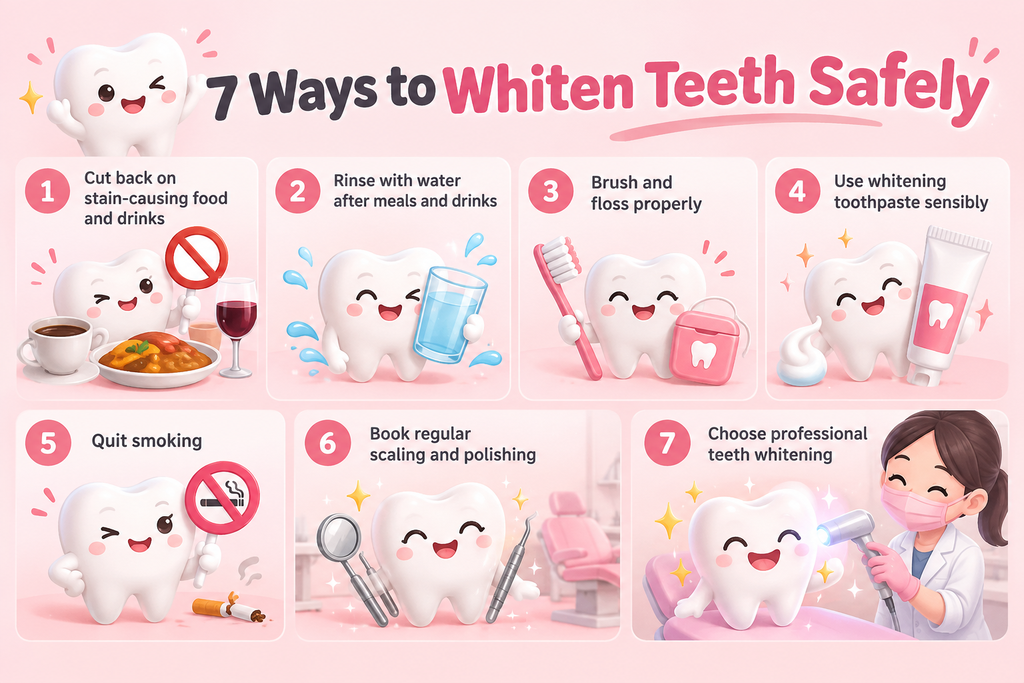
1. Cut back on stain-causing food and drinks
Coffee, tea, red wine, curry, dark sauces, dark berries and sugary drinks are the usual culprits. You do not need to give them up. Having them with meals, sipping through a straw and not nursing one cup for hours all reduce how long pigments sit on your enamel.
2. Rinse with water after meals and drinks
A quick rinse or a few sips of plain water washes away leftover pigments and food debris. Staying well hydrated also keeps saliva flowing, which helps protect your teeth from decay. After acidic foods or drinks, wait about 30 minutes before brushing so softened enamel is not scrubbed away.
3. Brush and floss properly
Brush twice a day with fluoride toothpaste and floss once daily to stop plaque from building up and dulling your teeth. Our guide to good oral hygiene habits covers technique in more detail.
4. Use whitening toothpaste sensibly
Whitening toothpaste can lift light surface stains, but it cannot change the natural colour of your teeth or reach deeper discolouration. Many contain more abrasive ingredients, so follow the label and ask your dentist how often is suitable for you.
5. Quit smoking
Tobacco leaves stubborn yellow-brown stains and also raises your risk of gum disease and bad breath. Stopping is one of the most effective ways to protect both the colour and the health of your teeth, and it is never too late to start.
6. Book regular scaling and polishing
Even careful brushing misses tartar and stains in hard-to-reach spots. A professional scaling and polishing session removes them, often brightening teeth noticeably on its own. Seeing your dentist at least once a year, or twice if your dentist advises, also catches decay and gum problems early.
7. Choose professional teeth whitening from a registered dentist
When stains stay put, professional teeth whitening is the most reliable option. A dentist protects your gums, applies a peroxide gel at a strength that is not available to the public, and adjusts the plan if you have sensitive teeth. This is also the only route that can lighten the natural shade of your teeth meaningfully.
Also Read: Toothache Getting Worse? Here’s What’s Going On
How to Whiten Teeth Naturally at Home
Searching for how to whiten teeth naturally brings up plenty of kitchen-cabinet hacks. Most of them only polish the surface, and some can do more harm than good.
Baking soda and charcoal
Both act as mild abrasives that scrub off surface stains. They do not bleach teeth, and gritty powders used too often can wear enamel. That makes teeth look more yellow over time, because the dentin beneath shows through more.
Lemon juice and other acidic hacks
Lemon juice, citrus peels and apple cider vinegar are acidic and can erode enamel, especially when mixed with baking soda. Eroded enamel does not grow back, so this is one trend worth skipping.
Natural vs Professional Teeth Whitening
Home habits keep teeth clean, while peroxide strength and supervision are what separate mild brightening from real whitening. Under Singapore rules, whitening products sold to the public can contain at most 0.1% hydrogen peroxide, and stronger products are only for use by or through registered dentists, as the Health Sciences Authority explains.
The Ministry of Health also reminds the public that whitening should be done by trained dentists. The table below shows how the main options compare.
| Option | Peroxide strength | Best for |
|---|---|---|
| Daily habits and whitening toothpaste | None or very low | Preventing and lifting light surface stains |
| Over-the-counter strips and gels | Up to 0.1% hydrogen peroxide | Mild surface stains, slow and limited results |
| Dentist take-home kit | Set by your dentist | Gradual whitening at your own pace |
| Dentist in-office whitening | Higher strength, with gum protection | Faster, more visible results in one visit |
Also Read: Dead Tooth: Symptoms, Causes & Treatment Options
Book Your Teeth Whitening Consultation at AllSmiles Dental Care
If your stains do not budge with better habits, professional whitening is worth a conversation. At AllSmiles Dental Care, our dentists assess your teeth and gums first, so you know what shade improvement is realistic for you and whether a cleaning should come before whitening.
We offer teeth whitening alongside scaling and polishing and routine check-ups at our clinics across Singapore. That makes it easy to keep your teeth clean, healthy and bright under one care team.
Wondering how to whiten teeth safely without trial and error? AllSmiles Dental Care is a family-oriented, full-service dental clinic in Singapore, and our team will help you choose an option that suits your teeth, lifestyle and comfort.
Book an appointment at your nearest AllSmiles clinic today. Walk-ins are welcome, though we encourage advance bookings.
Frequently Asked Questions
Can yellow teeth become white again?
It depends on the cause. Surface stains often lift with scaling and polishing, and professional whitening can lighten the natural shade of many teeth. Grey or blue discolouration, and stains linked to medication or injury, may respond less. Crowns, fillings and veneers will not change colour.
How can I whiten my teeth in one day at home?
No safe home method whitens teeth fully in a day, because products sold to the public are limited to 0.1% hydrogen peroxide. Brushing, flossing and rinsing can freshen up recent stains. If you need a visible change quickly, in-office whitening by a dentist is the fastest route.
Does whitening toothpaste actually work?
It can remove some surface stains, but it does not bleach teeth or change their natural colour. Because it can be more abrasive than regular toothpaste, use it as directed and ask your dentist if it suits you.
Is teeth whitening safe in Singapore?
Whitening done by a registered dentist after an oral check is considered safe for suitable patients. Temporary sensitivity can happen, and your dentist can manage it. Avoid strong kits sold online with unclear labelling, as unsupervised high-strength products can injure your gums.