Cavities and gum disease remain common among Singapore adults, even though the country fluoridates its tap water and runs dental programmes in schools. The gap usually opens up in adulthood, when daily habits matter far more than the occasional visit to the dentist.
Good oral hygiene is built at home, between appointments. Here are eight dentist-recommended habits, adapted for how we eat, drink and live in Singapore, along with the mistakes to avoid and the signs that it is time to book a check-up.
It is important to keep good dental health due to a few reasons we will discuss in this article, as well as eight oral hygiene habits that you can and should adopt to cover all your bases and improve your self-care routine.
What Is Oral Hygiene
Oral hygiene is the practice of keeping your teeth, gums and tongue clean to prevent plaque buildup, cavities, gum disease and bad breath. It combines daily care at home, such as brushing and cleaning between your teeth, with regular professional check-ups and cleaning.
Good oral hygiene shows up as pink gums that do not bleed when you brush or floss, teeth that are free of pain, and breath that stays fresh through the day. Most problems start with plaque, the sticky film of bacteria that forms after every meal, so the goal is to remove it daily before it hardens into tartar.
8 Oral Hygiene Habits to Build Into Your Daily Routine
These eight oral hygiene habits work together, so the biggest gains come from doing the basics consistently rather than chasing the latest gadget.
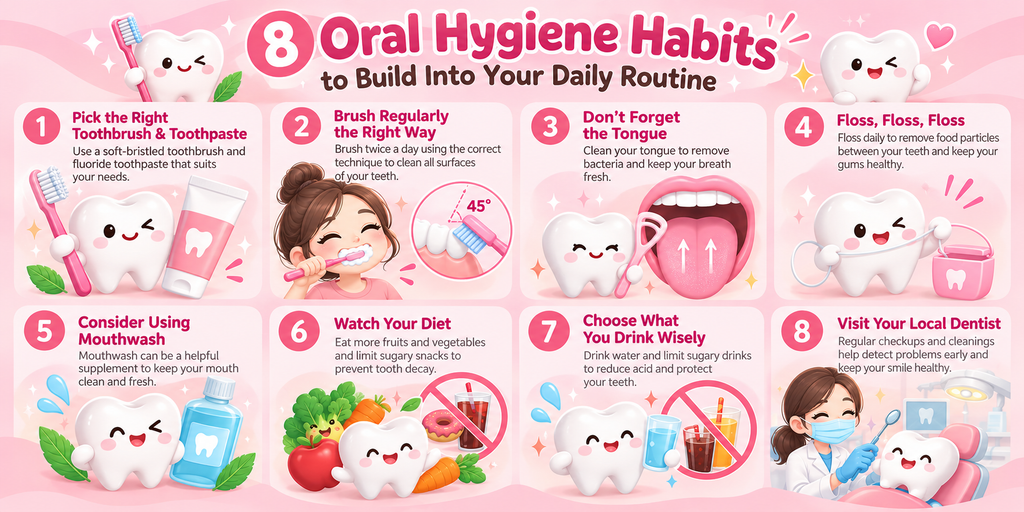
1. Pick the Right Toothbrush and Toothpaste
According to the Oral Health Foundation, adults should choose a toothbrush with a small to medium-sized head, as long as it is small enough to reach into the crevices of your teeth and gums where food debris usually remains after mealtimes.
There are smaller brushes for children out there in the market today as well.
For most people, a soft-bristled brush is the most comfortable choice as medium and hard bristles can damage your enamel and gums and cause them to bleed if you brush too vigorously.
Are Electric Toothbrushes Better Than Normal Toothbrushes?
So what about electric toothbrushes? Do they clean better? Studies have shown that there are not many differences between electric and normal toothbrushes in removing plaque, although a rotation oscillation toothbrush (where the bristles go-round, back and forth) is the most effective and it is particularly useful for those with limited arm or hand movement.
For your choice of toothpaste, you will also notice many varieties such as “total care” that includes ingredients to freshen breath as well as reduce plaque build-up, or “whitening” that are somewhat effective in removing stains but not strong enough to actually alter the shade of your teeth.
Whichever variety you choose, always opt for one with fluoride as it helps strengthen and protect your teeth, preventing tooth decay. We would encourage adults to use fluoridated toothpaste. On the other hand, we would also advise children to use fluoride-free toothpaste unless they have active cavities. This is to prevent fluorosis.
2. Brush Regularly the Right Way
Brushing is one of the most common ways to build good oral hygiene habits and twice a day after meals are plenty enough for most people. Brush well using the right method following this four-step process:
- Hold your toothbrush at a 45-degree angle against the gums.
- Move the brush back and forth gently in short, circular strokes.
- Brush the outer, inner tooth surfaces, as well as the top areas where chewing often occurs.
- Hold the brush vertically and use the tip to clean the inside surfaces of the front teeth, using gentle up-down strokes.
Remember to change your toothbrush every two to three months as worn-out bristles may not clean your teeth well and may even damage your gums. Many people tend to coat the entire head of their toothbrush with toothpaste when only a pea-sized amount is needed. Some even say to spit instead of rinse after brushing to keep the fluoride staying on your teeth for a longer period of time.
3. Don’t Forget the Tongue
Bacteria live in every corner in your mouth including on the tongue. Although brushing removes bacteria from your teeth and gums, it can still remain on your tongue, causing bad breath from odour-causing germs. Keeping your tongue clean also boosts your immunity levels and gut health as you get rid of toxins that initially occur in the mouth. So how do you brush your tongue
You can start by brushing the back, moving towards the front before rinsing. For more thorough cleaning, opt to use a tongue scraper that is sold at most pharmacies these days. Made of either soft, flexible plastic or metal, the scraper helps to rid your tongue of mucus-looking waste. Just be cautious not to scrape too hard as it may cause soreness and even bleeding.
4. Floss, Floss, Floss
Even if you brush regularly, there is still a chance of food particles remaining between your teeth and gums. Flossing is important as part of one’s oral hygiene habits because it reaches into your crevices that are hard for a brush to reach. Studies have also shown that people who brushed and flossed regularly were less likely to have bleeding gums and gingivitis.
Flossing is also a more convenient alternative to brushing your teeth in the middle of the day. Here’s how to floss effectively:
- Use about 18 inches of floss and wind it around the middle fingers of each hand, hold it taut between your thumbs and forefingers.
- Guide the floss between your teeth using a rubbing movement.
- At the gum line, curve the floss against one tooth and gently slide it into the space between the gum and tooth.
- Move the floss in an up-down motion, conforming to the shape of the tooth.
- Repeat this for the rest of your teeth.
5. Consider Using Mouthwash
Mouthwash is a supplement, not a substitute for brushing and cleaning between your teeth. If you brush and floss with the right technique every day, you may not need one. A rinse can help when brushing is inconvenient, and your dentist may recommend an antimicrobial mouthwash for a short period if you have gum problems. Use it at a different time from brushing so it does not wash away the fluoride from your toothpaste.
6. Watch Your Diet
Yes, the foods you choose to eat can affect your oral health. As explained, tooth decay happens when plaque comes in contact with sugar in the mouth, causing acid to form and eroding teeth and gums. Hence, if you consume too many sugar-filled snacks, there is a higher risk of bacteria forming in your mouth especially when you eat sugary foods as a midnight snack and sleep without brushing.
On the other hand, eating fruits and vegetables help to protect your teeth. These healthier options tend to stimulate the production of saliva, cleansing the mouth and reducing the acid. Even chewing sugar-free gum after meals can help prevent tooth decay and cavities.
7. Choose What You Drink Wisely
Besides the foods you eat, the drinks that you consume are also important to maintain oral hygiene. Sugary beverages such as soda and fruit juices should be consumed in moderation and even if you must have them, try drinking them with a straw to avoid the sweet liquid passing through your teeth and sticking to the surfaces in your mouth.
Drinking water with or after your meals also helps rid your mouth of leftover debris and bacteria, thus reducing acid production. If you have access to fluoride water, that is the icing on the cake as fluoride is a mineral that resists tooth decay and other gum diseases.
8. Visit Your Local Dentist
Just like annual medical checkups, you need regular dental checkup as well. Regular checkups are important to detect and prevent oral diseases especially if you have pre-existing conditions such as diabetes. Your dentist will evaluate your teeth and gums to evaluate your risk of tooth decay, as well as recommend ways you can maintain good oral hygiene habits.
Regular cleanings are also essential to help remove the buildup of plaque and tartar and eliminate the occurrence of gum diseases. These will include the stains on your enamel and possibly a fluoride treatment to strengthen your teeth against decay and demineralisation.
Common Oral Hygiene Mistakes to Avoid
Even people with good intentions slip up on the details, and these are the most common ones we see.
- Brushing too hard. Heavy pressure wears enamel and pushes gums back, so let the bristles do the work.
- Brushing straight after eating. Wait 30 to 45 minutes so you do not brush away softened enamel.
- Rinsing away your toothpaste. Spit out the excess but skip the water rinse, so the fluoride stays on your teeth longer.
- Snacking after your night-time brush. Plaque starts to rebuild as soon as you eat.
- Using a worn brush. Frayed bristles clean poorly and can irritate your gums.
- Skipping floss because your gums bleed. Bleeding usually signals inflamed gums, so keep cleaning gently and see a dentist if it continues.
- Waiting for pain. By the time a tooth hurts, the problem is often advanced.
Oral Hygiene for Children
Start brushing as soon as your child’s first tooth appears, twice a day with fluoride toothpaste. Older advice to use fluoride-free toothpaste for children is outdated. HealthHub’s guidance recommends a rice-grain smear for children under three who are at higher risk of decay, and a pea-sized amount from age three, while making sure they do not swallow it. A dentist can assess your child’s risk at the first visit, ideally around age one, and mouthwash is not recommended for children under six.
When to See a Dentist About Your Oral Hygiene
Book a visit if your gums bleed regularly, look red or swollen, or seem to be pulling away from your teeth. The same goes for bad breath that does not improve with brushing and tongue cleaning, new sensitivity or pain, or a mouth sore that has not healed within two weeks. Good habits at home lower your risk, but they cannot replace a professional examination.
At AllSmiles Dental Care, our dentists examine your teeth and gums, remove built-up plaque and tartar, and review your brushing and cleaning technique. We can also recommend the tools that suit your mouth, whether that is a particular interdental brush size or an electric toothbrush.
Book Your Oral Hygiene Check-Up With AllSmiles Dental Care
AllSmiles Dental Care has clinics across Singapore, including Bedok, Punggol, Sengkang, Holland Village and Rochor. Walk-ins are welcome, but we encourage you to book in advance so we can reserve enough time for your visit.
Ready to give your teeth and gums the care they deserve? Book your appointment today and let our team help you build an oral hygiene routine that works for you.
Frequently Asked Questions
How often should I brush my teeth?
Brush at least twice a day, in the morning and before bed, for two minutes each time with fluoride toothpaste. If you have just eaten, wait 30 to 45 minutes so your saliva can restore the mouth’s natural pH before you brush.
Is an electric toothbrush better than a manual toothbrush?
Either can clean well when your technique is right. An electric toothbrush can be helpful if you have limited hand movement or find manual brushing difficult, and many models include timers. Whichever you choose, use a soft brush and replace it or the brush head every three months.
Do I need to use mouthwash?
Not necessarily. If you brush and clean between your teeth properly every day, you may not need one. Your dentist may recommend an antimicrobial mouthwash for a short period if you have gum problems.
How can I improve my oral hygiene quickly?
Start with your night-time routine: clean between your teeth, brush for two minutes with fluoride toothpaste, spit out the excess and avoid eating or sugary drinks afterwards. A professional scaling and polishing can then give you a clean starting point.
How often should I see a dentist?
Most adults benefit from a check-up and cleaning about every six months. If you have active cavities or gum disease, you may need to come in more often, and your dentist will set the interval based on your risk.
How do I get rid of bad breath?
Clean your tongue and between your teeth daily, as bacteria and food debris in these areas are common causes. If bad breath persists, it may signal gum disease or cavities, so see a dentist.