Some people only find out they have an impacted tooth during a routine X-ray. Others notice a sore, swollen patch of gum at the back of the mouth that keeps coming back, or an adult tooth that never seems to arrive.
Whether an impacted tooth needs treatment depends on which tooth it is, where it sits and whether it is causing problems. This guide explains the causes, signs and treatment options for patients in Singapore, including when to simply monitor the tooth and when to act.
What Is an Impacted Tooth
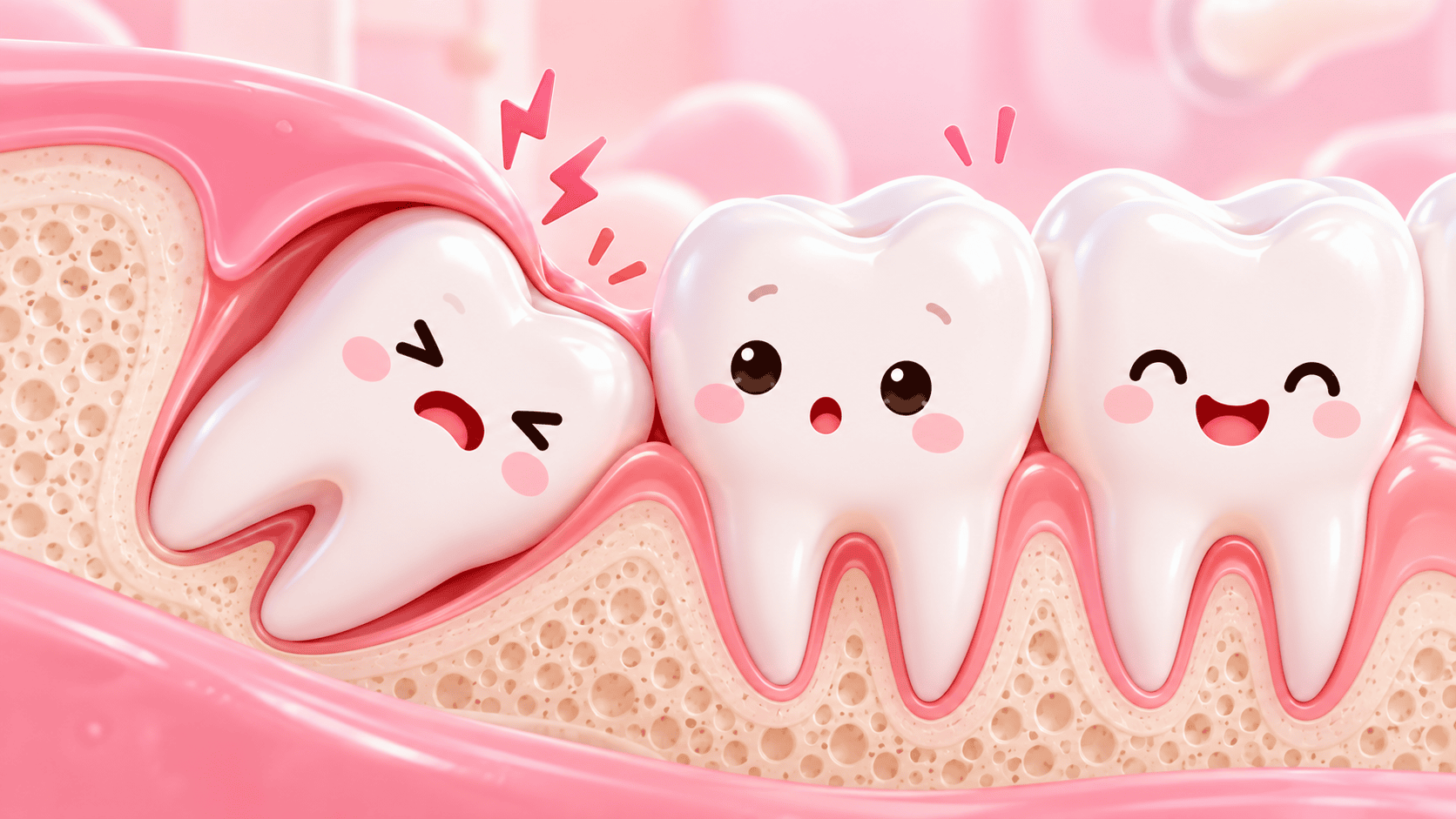
An impacted tooth is a tooth that stays trapped in the gum or jawbone instead of growing into its proper place. It may stay completely hidden or break through only partly. Wisdom teeth are affected most often, followed by the upper canines (eye teeth), although leading dental references note that any tooth can be impacted.
Many impacted teeth cause no discomfort and are picked up on dental X-rays. Others trigger pain, swelling or infection, which is why a proper assessment matters.
Erupted vs Impacted Tooth
An erupted tooth has fully come through the gum and can be cleaned like any other tooth. An impacted tooth cannot, so the differences show up in how it looks, how easy it is to clean and what happens if problems develop.
| Feature | Erupted Tooth | Impacted Tooth |
|---|---|---|
| Position | Fully through the gum | Partly or fully trapped in gum or bone |
| Visibility | Fully visible | Partly visible or completely hidden |
| Cleaning | Brushing and flossing reach all surfaces | Hard to clean, especially when partly covered by gum |
| Typical concerns | Cavities and gum disease, like any tooth | Gum infection, decay in the neighbouring tooth, cysts |
| Common management | Routine care | Monitoring, removal or orthodontic alignment |
Types of Impacted Tooth
Dentists describe impaction by how deeply the tooth is trapped. For wisdom teeth, they also note the angle, such as vertical, horizontal, or tilted towards the front or back of the mouth.
Soft Tissue Impaction
The tooth has moved through the jawbone but is still covered by gum tissue, so it may look partly buried or not show at all. Food and bacteria can collect under the gum, which makes the area prone to redness, swelling and infection.
Partial Bony Impaction
Part of the tooth has pushed through the bone, but the rest remains trapped in the jaw, and no part has broken through the gum. It can press on the neighbouring tooth and is hard to clean around, so an X-ray is needed to see its exact position.
Full Bony Impaction
The tooth is completely enclosed within the jawbone. This type is often found only on an X-ray and may cause no symptoms for years, but it still needs regular monitoring because problems such as cysts can develop silently.
Also Read: Is Your Wisdom Tooth Pain Normal? Here’s How to Tell
Impacted Tooth Causes
An impacted tooth usually comes down to a lack of room or a blocked path, not something you did wrong.
Not Enough Space in the Jaw
A small jaw or crowded teeth can leave too little room for a tooth to come through. Wisdom teeth, the last to arrive, are the most affected.
Teeth Growing at an Angle
Crooked or twisted teeth can grow in sideways and press against the tooth beside them, blocking their own way out.
Extra Teeth or Growths
Extra (supernumerary) teeth, or growths in the jaw, can sit in the path of a tooth that is trying to erupt.
Baby Teeth That Fall Out Too Early or Too Late
Baby teeth hold space for adult teeth. If one is lost very early, neighbouring teeth can drift into the gap and cause crowding or impaction. If a baby tooth stays too long or becomes fused to the bone, it can block the adult tooth underneath.
Family History
Impacted teeth tend to run in families, so a parent or sibling with the same problem raises the likelihood.
Impacted Tooth Symptoms
Some impacted teeth cause no symptoms for years. When symptoms do appear, they tend to come and go and usually involve the gum around the tooth. Common signs include:
- Pain near the back of the jaw, especially around the last molar
- Red, swollen or bleeding gums around the tooth
- Bad breath or an unpleasant taste in the mouth
- Difficulty opening the mouth fully
- Jaw pain or headaches
- Swollen lymph nodes under the jaw or in the neck
In children, an adult tooth that is much later than its partner on the other side, or a baby tooth that stays well past its time, is worth a dental check.
Is an Impacted Tooth Dangerous
An impacted tooth is not always dangerous, and many cause no lasting harm. The risk depends on the tooth’s position, whether it can be kept clean and whether it is already causing symptoms. Problems that can develop include:
- Decay in the impacted tooth and the neighbouring tooth, because food and bacteria collect where cleaning is difficult
- Infection of the gum covering a partly erupted tooth, known as pericoronitis
- Gum disease and bone loss around the neighbouring tooth
- Cysts, and rarely tumours, that can damage the jawbone and nearby teeth
- Pressure on neighbouring teeth and bite problems
National Dental Centre Singapore points out that these problems can develop silently, so a check-up is advisable even when nothing hurts. Seek urgent dental or medical care if you develop facial swelling, fever, a sore throat or difficulty breathing, as these can signal a spreading infection.
Impacted Tooth X-ray and Diagnosis
Most impacted teeth cannot be confirmed by looking in the mouth alone, so diagnosis combines an examination with imaging.
Dental Examination
- Your dentist checks the gums and neighbouring teeth for swelling, decay or infection
- A medical history is taken, so bring a list of your medications
- Nearby teeth may be tested to confirm they are still healthy
Dental X-ray
- The X-ray shows whether a tooth is impacted, how it is angled and how close it sits to neighbouring roots and the jawbone
- For lower wisdom teeth, it helps judge the tooth’s position relative to the nerve in the jaw, and a 3D scan may be added in more complex cases
- Our dental X-ray service uses digital radiography to locate hidden teeth while keeping radiation exposure low
Also Read: Diastema (Tooth Gap): Causes, Signs and Treatment
Impacted Tooth Treatment Options
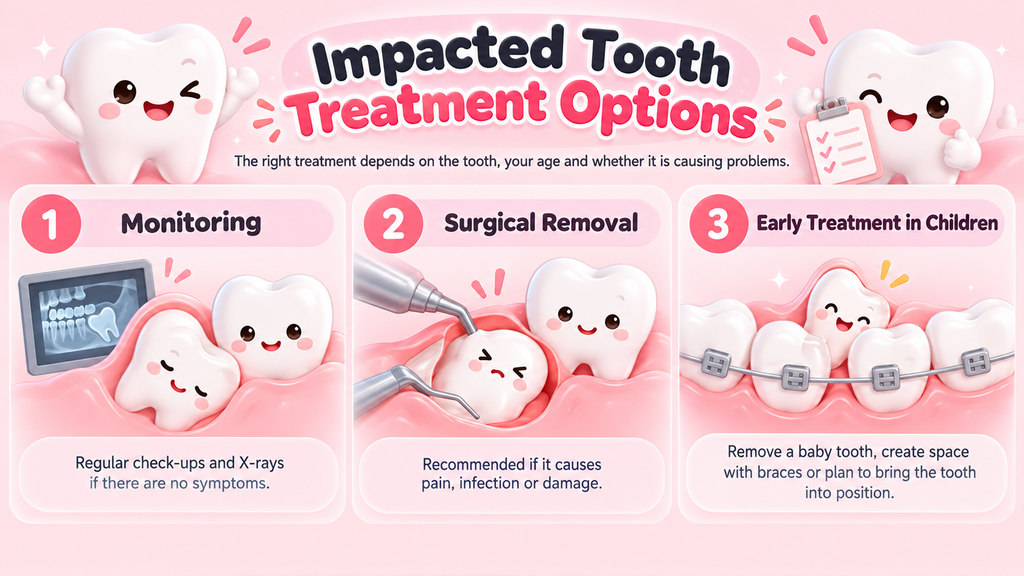
There is no single treatment for every impacted tooth. The right option depends on the tooth, your age and whether it is causing problems.
Monitoring
If the tooth causes no symptoms and is not harming neighbouring teeth, your dentist may simply watch it with regular check-ups and X-rays.
Surgical Removal
Removal is usually advised for impacted wisdom teeth that cause pain, infection or damage. It is a minor surgical procedure, usually done under local anaesthesia, where the gum is lifted, the tooth is sometimes divided into sections, and the gum is stitched back. Swelling and bruising typically build over the first 72 hours before easing, and opening wide may feel harder for a few days.
Early Treatment in Children
When an impacted canine is spotted in a child or teenager, early action can avoid more complex treatment later. Depending on the case, the dentist may remove a baby tooth that is in the way, create space with braces or plan to bring the tooth into position.
Impacted Tooth Braces and Canine Treatment Time
When an impacted tooth is worth saving, as with a canine, the goal is to guide it into the dental arch rather than remove it. This usually involves teamwork between an orthodontist and an oral surgeon, and your dentist will advise which parts can be done in the clinic and which may involve a specialist.
Creating Space With Braces
- Orthodontic braces move neighbouring teeth to open a gap for the impacted tooth
- A baby tooth that is still in place may be removed
Exposure and Bonding
- The gum covering the tooth is gently opened to expose it
- A small bracket with a tiny chain is bonded to the tooth
- The gum is repositioned or left open, depending on the tooth’s position and the technique chosen
Guiding the Tooth Into Place
- Braces apply gentle, steady traction on the chain over several months
- Regular reviews and X-rays track the tooth’s progress
Impacted Canine Tooth Treatment Time
Published case reports and clinical guides commonly describe total treatment of around one to two years as part of overall orthodontic care. Simpler cases can be faster and complex ones longer, and your dentist can give a better estimate once the X-rays are reviewed.
Get Your Impacted Tooth Checked at AllSmiles Dental Care
See a dentist if you notice pain or swelling at the back of your jaw, gums that keep becoming inflamed, difficulty opening your mouth, or a child’s adult tooth that is much later than expected. Because an impacted tooth can cause problems silently, an X-ray during a routine check-up is often how it is found early, before it affects neighbouring teeth.
Don’t wait for pain to start. Book an appointment at any AllSmiles Dental Care clinic across Singapore for an examination and dental X-ray. Our dentists will explain what the X-ray shows and walk you through your options, from monitoring to wisdom tooth removal or orthodontic care.
Frequently Asked Questions
What is the impacted tooth ICD-10 code?
The ICD-10 code for impacted teeth is K01.1, a diagnostic classification used in medical records and insurance claims. You do not need to quote it yourself, as your dentist records the diagnosis in your notes.
Can an impacted tooth cause headaches?
It can. Jaw pain and headaches are among the reported symptoms, especially when the gum around the tooth is inflamed or infected. Headaches have many causes, so a dental examination and X-ray can help show whether an impacted tooth is involved.
Does every impacted tooth need to be removed?
No. If the tooth is not causing pain, infection or damage, your dentist may recommend monitoring it with regular check-ups. Removal or orthodontic treatment is considered when problems develop or are likely to.
Is impacted tooth removal painful?
The area is numbed with local anaesthesia, so you should feel pressure but little or no pain during the procedure. Some swelling and discomfort afterwards is normal and can be managed with the medication your dentist prescribes. For complex cases, other anaesthesia options may be discussed.
Will an impacted tooth go away on its own?
In young patients, a late adult tooth may still come through, which is why dentists often monitor first. Once an impacted tooth causes pain or swelling, it will not settle on its own and needs a dentist’s assessment.
Can I use MediSave for impacted tooth treatment?
Yes, but only for surgery. You can use MediSave for surgical wisdom tooth removal at a participating private dental clinic, and the amount you can claim depends on the type of operation. Non-surgical care, such as braces or a simple extraction, is generally not claimable, so ask your dentist whether your treatment qualifies.