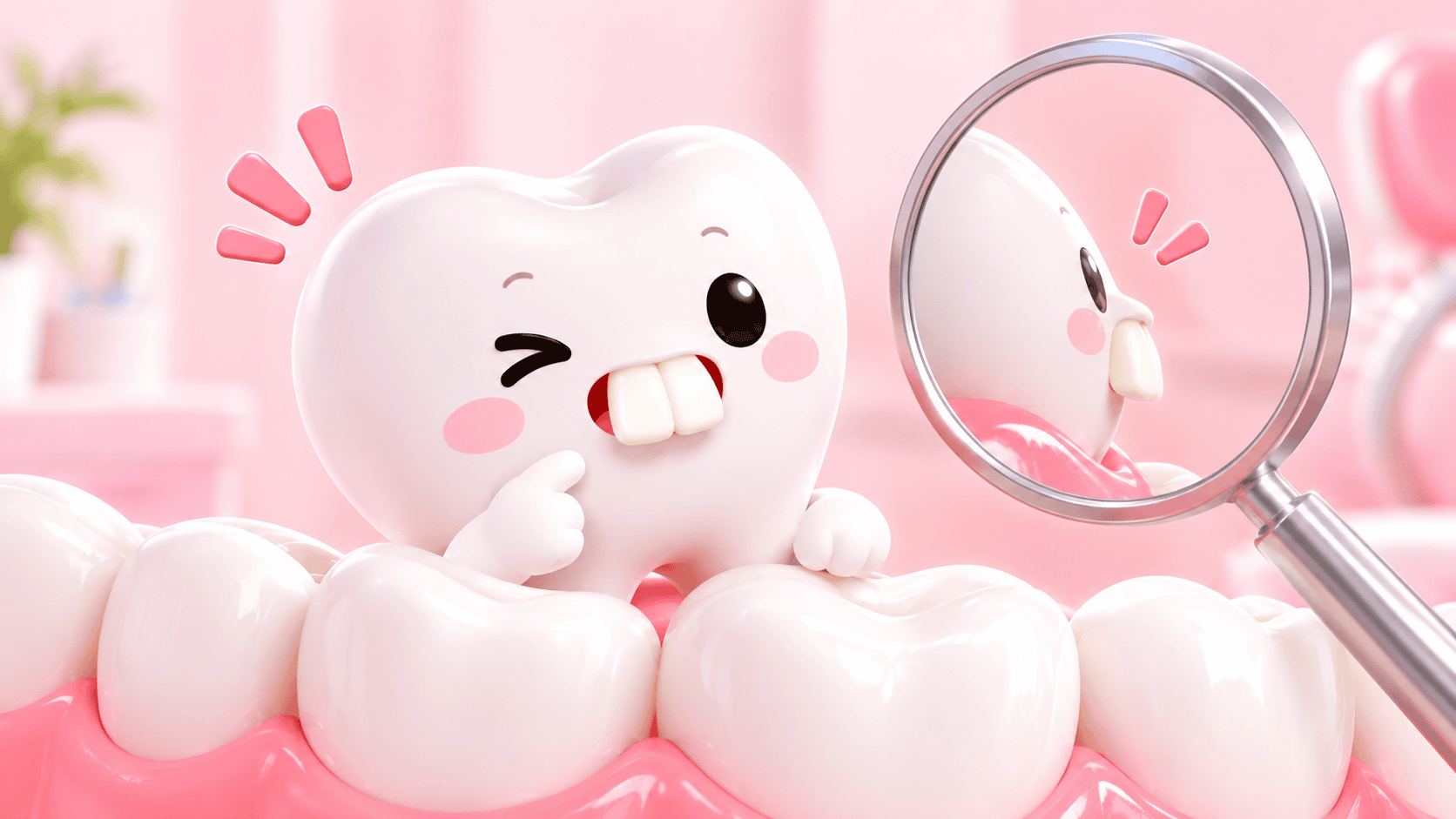
If your upper front teeth stick out more than you would like, you are probably wondering whether it is simply the way your smile is built or something that needs attention. In most cases, buck teeth come down to how your teeth and jaws fit together, and they can be assessed during a routine dental visit.
Dentists usually describe the problem as an increased overjet. This guide explains what buck teeth are, what causes them, which problems they may bring and how they can be corrected, whether you are a parent checking on a child or an adult thinking about treatment.
What Are Buck Teeth?
Buck teeth is an everyday term for upper front teeth that sit noticeably ahead of the lower front teeth. In dental terms, it usually points to an increased overjet, which is the horizontal distance between the edges of the upper and lower front teeth when you bite down. Orthodontists generally regard an overjet of roughly 1 to 3 mm as ideal.
Many cases fall under what orthodontists call a Class II division 1 bite, which pairs upper front teeth that tilt outwards with an increased overjet. In a National University of Singapore study of young male army recruits, about 26.3 per cent had this pattern, making it the second most common bite pattern in the group, after Class I at 48.1 per cent.
Is Overjet the Same as an Overbite?
Not quite, although many websites use the two terms interchangeably. Overjet is how far the upper front teeth stick out horizontally, while overbite is how much they overlap the lower front teeth vertically. Buck teeth are mainly about overjet.
You can have an increased overjet with a normal overbite, or the other way round. Dentists measure both because the combination affects which treatment suits you.
Signs of Buck Teeth
Buck teeth are easy to spot in the mirror, but some signs only show when you bite down or relax your lips. The table below sets out what each sign may mean and when it is worth raising with a dentist.
| Sign | What it may suggest | Worth checking when |
|---|---|---|
| Upper front teeth tilt or sit forward | Teeth angled outwards, or an upper jaw sitting ahead of the lower jaw | The look bothers you in photos or in profile |
| Visible gap between upper and lower front teeth when biting | Increased overjet | Biting into food with your front teeth feels awkward |
| Lips are hard to close comfortably at rest | Front teeth prominent enough to get in the way of lip closure | You often keep your mouth slightly open |
| Lower teeth press into the gum behind the upper teeth | Lower jaw set back, with the bite closing deeply | You notice soreness or gum irritation |
| Chipped or knocked front teeth | Protruding teeth are more exposed to impact | After any fall or sports knock |
What Causes Buck Teeth
Buck teeth rarely come from a single cause. Most cases involve a mix of the factors below.
Genetics and Jaw Growth
Jaw size and shape run in families. Buck teeth often appear when the upper jaw sits further forward than the lower jaw, or when the lower jaw is smaller or set back. In these cases the pattern is inherited and not something a parent could have prevented.
Thumb Sucking and Pacifier Use
Prolonged thumb, finger or pacifier habits press against the upper front teeth and push them outwards, especially while permanent teeth are coming through. These habits can also change the shape of the roof of the mouth.
Tongue Thrusting
If the tongue pushes forward against the front teeth every time you swallow, the repeated pressure can gradually move the teeth out of position.
Tooth Size, Crowding and Missing Teeth
Teeth that are large for the space available, or crowding that pushes the upper front teeth forward, can make them look prominent. Missing teeth can also let neighbouring teeth drift.
Injury and Early Baby Tooth Loss
A knock to the mouth can shift the teeth or jaw. Baby teeth lost too early without space being kept can also let the remaining teeth move.
Problems Buck Teeth Can Cause
Mild buck teeth may need no treatment, but a more pronounced overjet can bring practical concerns.
Higher Risk of Dental Injury
Protruding upper front teeth are more exposed to knocks during sports, play and falls. The NDCS notes that early treatment of protruding upper incisors may reduce the risk of injury. If you play contact sports while waiting for treatment, a custom mouthguard can help protect your teeth.
Gum and Cleaning Difficulties
In some Class II cases, the lower teeth bite into the gum behind the upper front teeth, which can cause pain or gum recession. Misaligned teeth can also be harder to clean thoroughly.
Chewing, Speech and Lip Closure
Some people find it hard to bite with their front teeth, struggle to close their lips comfortably, or find certain sounds harder to pronounce.
Confidence
Many people feel self-conscious about how their teeth look in photos or when they smile. That is a perfectly valid reason to ask about treatment, even when the bite works well.
Also Read: Open Bite: Types, Causes and Treatment
How Buck Teeth Are Diagnosed
A dentist can usually recognise buck teeth during a routine check-up. A fuller assessment looks at the teeth, the bite and the jaws together.
Dental Examination
The dentist looks at how your teeth come together and notes:
- How far the upper front teeth sit in front of the lower ones
- How much the upper teeth overlap the lower ones vertically
- The condition of your gums and the position of your lips
- Habits such as thumb sucking or tongue thrusting
X-Rays and Records
To see what lies beneath the surface, the dentist may use:
- X-rays to check jaw position and tooth roots
- Photos, impressions or digital scans to plan tooth movement
- A referral to an orthodontist if the jaw is significantly involved
Treatment Planning
Once the cause is clear, the dentist will discuss:
- Whether the problem is mainly in the teeth or also in the jaws
- Which treatment options suit your age, bite and goals
- How long treatment may take and what aftercare involves
How to Fix Buck Teeth
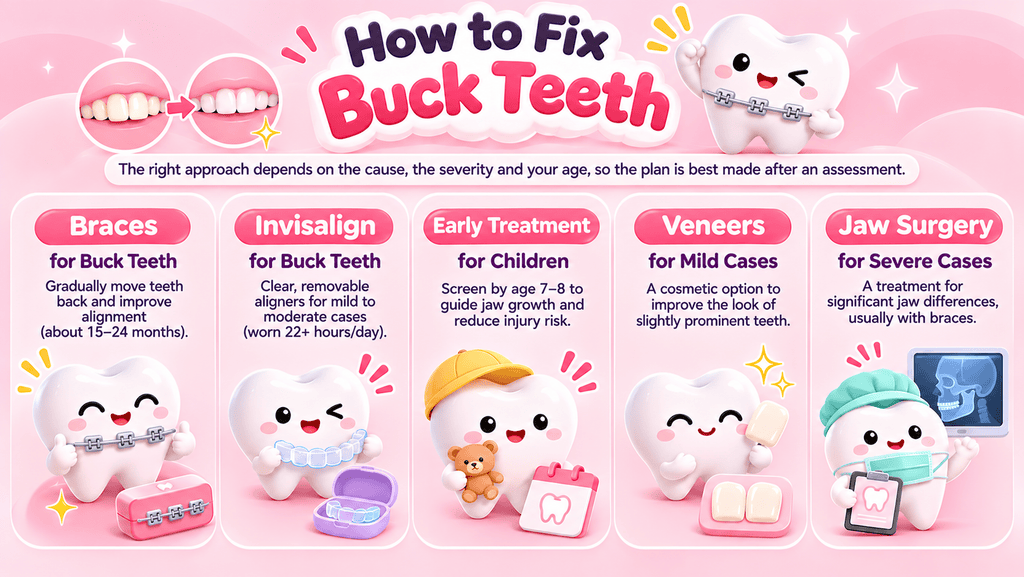
The right approach depends on the cause, the severity and your age, so the plan is best made after an assessment.
Braces for Buck Teeth
Braces are the most widely used way to correct buck teeth. Brackets and wires gradually move the upper front teeth back and improve how the teeth meet. Depending on the case, small elastics may be added, or some teeth may be removed to create space. HealthHub puts the average treatment time at about 15 to 24 months, and adults can start braces too, although treatment may take a little longer. Orthodontic braces at AllSmiles follow this approach, and retainers are worn afterwards to hold the new position.
Invisalign for Buck Teeth
Clear aligners can suit mild to moderate buck teeth. They are removable, worn at least 22 hours a day, and often use small tooth-coloured attachments to help guide movement. Some cases also need elastics, and more complex jaw-related cases may be better suited to braces. Invisalign at AllSmiles begins with an assessment to check suitability.
Early Treatment for Children
The Association of Orthodontists (Singapore) recommends that children be screened by around seven to eight years old. Early appliances can guide jaw growth, may lower the risk of injury to protruding teeth and can make later treatment simpler, although many children still need braces afterwards.
Veneers for Mild Cases
When the teeth are only slightly prominent and the bite is healthy, a dentist may consider veneers to change how the front teeth look. Veneers do not move teeth or correct the bite, and they may involve reshaping the tooth surface, so they suit only selected cases.
Jaw Surgery for Severe Cases
Where the jaws differ significantly in size or position, an orthodontist and oral surgeon may discuss corrective jaw surgery alongside braces. This is uncommon and reserved for more severe skeletal cases.
Also Read: Diastema (Tooth Gap): Causes, Signs and Treatment
Can Buck Teeth Be Prevented?
When buck teeth are inherited, there is little a family can do to prevent them. What parents can influence is the habit side. Helping children move away from thumb sucking and pacifiers, and arranging an orthodontic check around age seven to eight, gives any developing problem the best chance of being caught early.
Regular dental check-ups help too, because changes in how the teeth and bite are developing can be spotted well before they become obvious.
Book a Buck Teeth Check at AllSmiles Dental Care
It is worth seeing a dentist if your front teeth are often knocked or chipped, biting feels difficult, the gum behind your upper teeth is sore, your child’s thumb-sucking habit is continuing, or you are simply unhappy with how your smile looks. A short assessment can show whether your buck teeth are mainly cosmetic or also affecting how your bite works.
At AllSmiles Dental Care, our dentists can assess your bite and talk you through suitable options, from orthodontic braces to Invisalign, starting with a dental check-up. Visit our clinic network across Singapore to book your appointment.
Frequently Asked Questions
Can buck teeth go away on their own?
Rarely, once the permanent teeth and jaws have developed, especially when jaw position or genetics are involved. In young children, stopping a habit such as thumb sucking early may help, so an early dental check is worthwhile.
Can adults fix buck teeth?
Yes. There is no age limit for orthodontic treatment, although it may take a little longer in adults because teeth move through denser bone. A dentist can advise whether braces or Invisalign suits your bite.
Can buck teeth be fixed without braces?
In mild cases, cosmetic options such as veneers may change how the front teeth look, but they do not move the teeth or correct the bite. Clear aligners are another option for suitable cases. DIY gadgets or unsupervised aligners are best avoided, as they may harm your teeth and gums.