
Flossing is a habit most of us know we should have, yet many people are unsure whether they are doing it properly. How much floss do you need? Should it go below the gumline? Is a little bleeding normal? Good technique is simpler than it looks and takes only a few minutes a day.
This guide explains each step in plain language, from cutting the floss to reaching your back teeth. It also covers tips for braces, how often to floss and when bleeding gums mean it is time to see a dentist.
How to Floss Teeth the Right Way
To floss teeth the right way, you guide a clean section of floss between two teeth, curve it into a C-shape against one tooth and move it gently up and down, reaching just below the gumline. You then repeat on the neighbouring tooth and move to a fresh section for the next gap.
This matters because a toothbrush cannot reach everywhere. A periodontist at the National Dental Centre Singapore explains that about 40 per cent of the tooth surface cannot be reached by brushing alone, and plaque left between teeth can lead to cavities and gum disease.
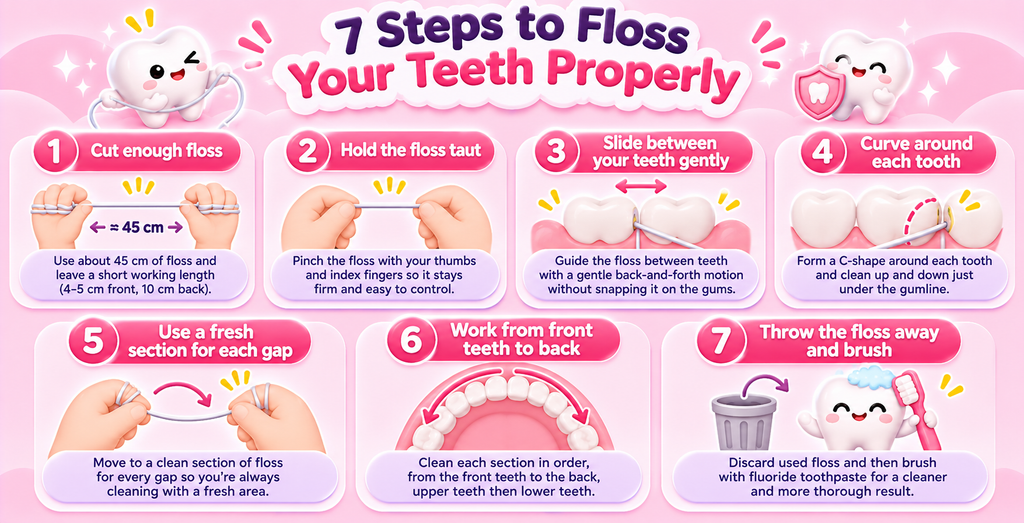
7 Steps to Floss Your Teeth Properly
Take a few minutes in front of a mirror the first few times. Flossing is a simple daily habit, and these seven steps show how to do it well.
1. Cut enough floss
Break off about 45 cm of floss, roughly an arm’s length, and wind most of it around the middle finger of each hand. It may feel like a lot, but a long piece gives you plenty of clean floss and stops you from reusing a section already covered in plaque.
Leave about 4 to 5 cm of working floss between your hands for the front teeth, and about 10 cm for the back teeth, where you need more length to curve around the tooth. Wash your hands first, since your fingers will be in your mouth.
2. Hold the floss taut
Pinch the floss between your thumbs and index fingers so it stays firm and easy to control. Loose floss tends to slip or snap against the gums, while a taut piece goes where you direct it.
Start with the upper or lower front teeth and work on one section of your mouth at a time. A mirror lets you see where the floss is going, which helps while you are still learning.
3. Slide the floss gently between your teeth
Guide the floss between two teeth with a gentle back-and-forth motion. Do not snap it down onto the gums, because pushing too hard can hurt or injure the gum tissue, and sore gums are a common reason people give up on flossing.
If two teeth are very tight, ease the floss through slowly rather than forcing it. Waxed floss tends to glide more easily through tight spaces.
4. Curve the floss around each tooth
Once the floss is between the teeth, wrap it into a C-shape against the side of one tooth. Slide it up and down two to three times, going just under the gumline. This is the part many people miss, yet it is where plaque collects.
Plaque is a sticky film of bacteria that forms on your teeth all the time. Once one side is clean, curve the floss against the neighbouring tooth and repeat, so both surfaces of the gap are cleaned.
5. Use a fresh section for each gap
After each gap, unwind clean floss from one finger and wind the used part onto the other. Working one gap at a time with a clean section means you are never cleaning with floss that is already loaded with plaque.
If the floss starts to shred or looks worn, move to a fresh length. Rinsing the floss as you go also helps wash away debris it has picked up.
6. Work from the front teeth to the back
Finish one section of your mouth before moving to the next, going from the front teeth to the back. Working section by section, upper teeth then lower teeth, helps make sure no gap is missed.
If you are new to flossing, begin with the front teeth, which are easier to handle, and add the back teeth as you gain confidence. Allow 5 to 10 minutes at first. With practice, the whole mouth takes about 2 to 3 minutes.
7. Throw the floss away and brush
Discard used floss instead of saving it for later, since it can fray and put bacteria back into your mouth. Then brush with fluoride toothpaste for about two minutes.
Flossing first clears the tight spaces, so the fluoride in your toothpaste can reach between your teeth more thoroughly. It also makes flossing harder to skip, because brushing first can leave your mouth feeling clean enough that flossing gets forgotten.
Also Read: Black Spots on Teeth: Are They Cavities or Stains?
How to Floss Back Teeth
Back teeth are harder to see and reach, so they are often skipped, yet food and plaque collect there just as easily. A few small adjustments make them much easier to manage.
Shape the floss for the back of your mouth
- Use a longer working length of about 10 cm.
- Hold the floss with your middle fingers, then use your index fingers to push the middle section upwards into a U-shaped curve.
Slide in and scoop under the gumline
- Ease the floss between the teeth and scoop gently under the gumline, as you would at the front.
- Take one gap at a time and use a fresh section each time.
Try a floss holder if your fingers make it hard
- A floss holder suits beginners, young children and people with limited finger dexterity.
- Holders are not recommended for misaligned teeth, so check with your dentist if you are unsure.
How to Floss With Braces
Braces make flossing trickier because the archwire blocks the usual path between teeth, yet plaque collects easily around brackets and wires. Cleaning between teeth still matters, and the right tools make it manageable. Your orthodontist can also show you what works best while you are in treatment with orthodontic braces.
Use a floss threader with waxed floss
- Thread about 30 to 45 cm of waxed floss through a floss threader. Waxed floss is less likely to shred on brackets.
- Slide the threader under the archwire, pull the floss through and clean both sides of the neighbouring teeth with a gentle up-and-down motion. Rethread for the next gap.
Add an interdental brush or water flosser
- Small interdental brushes clean around brackets and under wires. Choose a size that fits snugly without forcing it.
- A water flosser can be a useful alternative when braces make it hard to move string floss between teeth, although brushing is still essential.
How Often Should You Floss Your Teeth Each Day?
Floss once a day, alongside brushing at least twice a day. HealthHub explains why night-time is a smart choice: saliva flow slows while you sleep, which gives bacteria more opportunity to damage your gums and teeth. Flossing before bed is a popular recommendation, but the best time is the one you will stick to. If food gets stuck during the day, floss it out right away.
On the question of order, either works if you do both thoroughly, but flossing first is considered more beneficial because it clears the tight spaces before the fluoride in your toothpaste reaches them.
Common Flossing Mistakes
Even people who floss daily can pick up habits that reduce the benefit or irritate the gums. These are four to watch for.
Snapping the floss into the gums
Forcing the floss down quickly can hurt or injure the gum. Use a slow, gentle motion and stop once you reach the gumline.
Moving the floss straight up and down
Floss picks are often used with a simple up-and-down motion that misses the curve around each tooth and the area under the gumline. Wrap the floss into a C-shape against each tooth instead.
Using the same piece of floss for every gap
Used floss can fray and deposit bacteria back into the mouth. Move to a clean section as you go and discard it afterwards.
Waiting until food gets stuck
Plaque keeps forming on your teeth every day. Flossing only when something is trapped leaves plaque untouched most of the time, so a daily routine does more.
Bleeding Gums When Flossing
Healthy gums are pink and should not hurt or bleed when you floss correctly. Light bleeding can happen if you are new to flossing or have pressed too hard, so check your technique first and keep your movements gentle.
Bleeding that keeps happening is different. HealthHub lists gums that bleed during brushing or flossing as a warning sign of gum disease, alongside red, puffy or swollen gums, receding gums and constant bad breath. In its early stage, this inflammation can often be reversed with good brushing and flossing habits. Tartar, however, is plaque that has hardened, and only a dental professional can remove it through scaling and polishing.
Also Read: Dental Fluorosis: Causes, Signs and Treatment
When to See a Dentist About Flossing Problems
Flossing removes plaque, but it cannot remove tartar or tell you what is happening beneath the gums. See a dentist if your gums bleed repeatedly, look red or swollen, or are pulling away from your teeth. The same applies if teeth feel loose or are shifting, if your bite feels different, if food keeps getting trapped in the same gap, or if flossing is painful or you cannot reach certain areas.
A dentist can find the cause and recommend the cleaning tool that suits the spacing of your teeth. Healthy gums usually need regular check-ups and cleaning every six months to a year, while inflamed gums may need gum disease treatment.
Keep Your Smile Clean and Healthy with AllSmiles Dental Care
At AllSmiles Dental Care, our dentists can check your teeth and gums during a dental checkup, show you flossing techniques that suit your mouth and recommend the right cleaning tools. If tartar has built up, scaling and polishing can leave your teeth feeling clean. If your gums are inflamed, our team can assess whether gum disease treatment is needed.
With clinics across Singapore, including Punggol, Sengkang, Jurong, Bedok, Holland Village and Rochor, AllSmiles Dental Care makes it easy to get personalised oral care advice close to home. CHAS, MediSave and CDC Vouchers are accepted, subject to eligibility, and walk-ins are welcome, though we recommend booking in advance. Contact us today to book your visit.
Frequently Asked Questions
Should you floss before or after brushing?
Either order is acceptable if the cleaning is thorough. Flossing first is considered more beneficial, because it clears the tight spaces and lets fluoride toothpaste reach between your teeth.
Is it normal for gums to bleed when you start flossing?
Light bleeding can happen if you are new to flossing or pressing too hard. If your gums keep bleeding, see a dentist to have them checked.
Can a water flosser replace string floss?
If string floss is hard for you to use, a water flosser can take its place alongside brushing. Brushing remains essential either way.
Does flossing cause gaps or gum recession?
Done correctly, floss should not make gums recede or teeth drift apart. Use a gentle up-and-down motion along each tooth and avoid snapping the floss.